
Willard Van Orman Quine 1908-2000
Obituaries - part 3
Obituaries part 3 (this page)
WVQ Web Site Map
WVQ Web Content by DBQ
- About WVQ
- Art by WVQ
- Articles by WVQ
- Audio recordings
- Avocations of WVQ
- Awards
- Book reviews (popular) by WVQ
- Book reviews (prof.) by WVQ
- Books by WVQ
- Books on WVQ (partial)
- Collected works by WVQ
- Collection: Philosophy of Quine
- Collection: Quintessence
- Degrees: "earned" and honorary
- Dictionary references to WVQ
- Dictionary reviews by WVQ
- Dissertations on WVQ (partial)
- Drawings by WVQ
- Essays by WVQ
- Family genealogy
- Fiction by WVQ
- Guestbook WVQ vol. 1
- Guestbook WVQ vol. 2
- Guestbook WVQ vol. 3
- Guestbook WVQ vol. 4
- Hobbies of WVQ
- Home Page for WVQ
- Interviews
- Lectures delivered
- Lectures unpublished
- Manuscripts unpublished
- Mass media references
- Memorials
- News of WVQ
- Newspaper - biography
- Newspaper - Kyoto prize
- Obituaries 1 (A-F, photographs)
- Obituaries 2 (G-P)
- Obituaries 3 (Q-Z)
- Obituaries 4 (talks 1)
- Obituaries 5 (talks 2)
- Paintings by WVQ
- Photographs of WVQ 10 decades
- Photography by WVQ
- Prizes
- Published Interviews
- Quine family genealogy
- Quotation Queries (find quotes)
- Quotes about WVQ
- Reviews (popular) by WVQ
- Reviews (professional) by WVQ
- Reviews of WVQ's books
- Search WVQ web site
- Site Map of WVQ Web Site
- Stamp newsletter by WVQ
- Students of WVQ: Ph.D. listing
- Students of WVQ: undergraduate
- Translations of WVQ books
- Travels
- Videotape Interviews
- Web sites by others
- Web sites - obsolete
DBQ Family Web Sites
- Quine Ancestors
- Quine Family Tree
- Boynton Ancestors
- Boynton Family Tree
- Willard Van Orman Quine
- Marjorie Boynton Quine
- Douglas Boynton Quine
- Robert Quine
![[SafeSurf Rated All Ages]](http://www.wvquine.org/safeall.gif) Obituaries, memorials, symposia, and photographs of Willard Van Orman Quine, mathematician and philosopher. Professor Quine was born June 25 1908 (anti-Christmas) and died December 25 2000 (Christmas). The last paper he presented was Three Networks: Similarity, Implication, and Membership in Boston (August 1998); it was published in Proceedings of the Twentieth World Congress of Philosophy, Volume 6. Extensive visitor comments regarding his philosophy may be read in the
read in the W V Quine guest book where you may
sign into (email) the guestbook:
Obituaries, memorials, symposia, and photographs of Willard Van Orman Quine, mathematician and philosopher. Professor Quine was born June 25 1908 (anti-Christmas) and died December 25 2000 (Christmas). The last paper he presented was Three Networks: Similarity, Implication, and Membership in Boston (August 1998); it was published in Proceedings of the Twentieth World Congress of Philosophy, Volume 6. Extensive visitor comments regarding his philosophy may be read in the
read in the W V Quine guest book where you may
sign into (email) the guestbook: ![[guestbook]](guest-link.gif) to post your comments & questions
. This page is maintained by
Douglas Boynton Quine; please e-mail recommended additions, or corrections to the
webmaster:
to post your comments & questions
. This page is maintained by
Douglas Boynton Quine; please e-mail recommended additions, or corrections to the
webmaster: ![[webmaster]](webmaster-link.gif)
News Media Obituary Texts (sources R-Z)
La Repubblica obituary for W V Quine - Dec 30 2000
morto Quine filosofo e logico - Lo studioso aveva 92 anni
di Franco Volpi
Se ne va con Willard Van Orman Quine - logico, matematico e filosofo statunitense - uno dei grandi maestri della filosofia del Novecento, un pensatore lucido e geniale che con la sua opera ha dato un contributo determinante allo sviluppo della filosofia analitica, di cui era considerato uno dei capiscuola. Nato il 25 giugno 1908 ad Akron, nell'Ohio, aveva conseguito il dottorato ad Harvard con Whitehead, e aveva poi trascorso un periodo di studi in Europa, venendo in contato con la Scuola di Varsavia e il Circolo di Vienna. Aveva conosciuto personalmente a Varsavia Lesniewski, Lukasiewicz e Tarski, a Vienna G del e Schlick, a Praga Carnap. Tornato ad Harvard nel 1933, vi aveva insegnato fino al 1977, prima come professore associato e dal 1948 come full professor, svolgendo nel corso degli anni anche un'intensa attivit di visiting professor, tra l'altro a São Paulo, Oxford, Adelaide, Tokio, Parigi e Uppsala. Confrontandosi specialmente con Carnap, Quine intende liberare l'empirismo logico del Circolo di Vienna dai suoi presupposti dogmatici, arricchendolo nel contempo con argomenti tratti dalla tradizione del pragmatismo americano. Inizialmente si era dedicato soprattutto a studi di logica e matematica (Methods of Logics, 1950), allargando per il suo orizzonte di ricerca gi in From a Logical Point of View (1953), una raccolta di saggi tra cui due fondamentali: On what there is (1948), che propone un'ontologia minimale, in cui ammesso solo il minor numero possibile di entit , e Two Dogmas of Empiricism (1951), che suscit una vasta controversia e apr nuove prospettive della filosofia analitica. Quine vi mette a nudo due presupposti dogmatici dell'empirismo logico: la distinzione tra "giudizi analitici" e "giudizi sintetici" - sostenendo l'impossibilit di conseguire un concetto chiaro di "analiticit " - e il cosiddetto "riduzionismo", secondo cui tutte le nostre proposizioni si possono ridurre a proposizioni empiriche verificabili. Per Quine nessuna proposizione pu essere verificata isolatamente, ma tutti i nostri enunciati si presentano per cos dire "di fronte al tribunale dell'esperienza sensibile come un collettivo".
Negli anni Cinquanta fu sempre pi attratto da questioni di ontologia e filosofia del linguaggio, maturando una sua originale posizione esposta nella sua opera maggiore: Word and Object (1960). Cercando di spiegare come il nostro uso del linguaggio ci connetta con il mondo, egli sostiene, contro Noam Chomsky, la tesi che il nostro comportamento linguistico una reazione a stimoli del nostro apparato percettivo, e illustra le sue argomentazioni con un celebre e controverso esempio: che cosa deve fare un linguista per compilare il vocabolario di un linguaggio a lui del tutto sconosciuto? L'osservazione empirica del comportamento linguistico, unico strumento a sua disposizione, insufficiente a stabilire una corrispondenza precisa di significati con la propria lingua. Quine giunge allora a sostenere la tesi dell'indeterminatezza della traduzione, quindi dell'indeterminatezza del significato e infine dell'indeterminatezza delle nostre teorie. Congetture, ipotesi scientifiche ed edifici teorici che noi costruiamo rimangono sempre sottodeterminati rispetto alla base empirica cui si riferiscono, e ci spiega perch ci possano essere due teorie fra loro incompatibili e tuttavia entrambe accordabili con i dati empirici.
Quindi ha proposto un'intera serie di strategie per evitare o superare pragmaticamente questa indeterminatezza, pubblicando una serie di studi che sono tra quanto di migliore il dibattito filosofico mondiale ha offerto negli ultimi decenni : The Ways of Paradox (1966), Ontological Relativity (1969), The Roots of Reference (1974), Theories and Things (1981), il brillante e gustosissimo dizionario filosofico Quiddities (1987), The Pursuit of Truth (1990) e From Stimulus to Science (1995). Tutti questi scritti, alcuni vere e proprie pietre miliari del pensiero analitico, tracciano un solco chiaro e profondo nell'accidentato territorio della filosofia del nostro tempo, e forniscono un orientamento metodologico che quanto di pi prezioso egli ci lascia in eredit .
The Review of Metaphysics obituary for W V Quine (September, 2001)
IN MEMORIAM: WILLARD VAN ORMAN QUINE (1908-2000)
On Christmas day 2000, Willard Van Orman Quine passed away at the age of ninety-two. With Quine's death, philosophy is deprived of the presence of a man whose intellectual force shaped Anglo-American philosophy for the last fifty years. Colin McGinn noted how Quine's "uncompromising consistency of purpose made his doctrines impossible to ignore. You either go with him or define your position in reaction to his." "And that," he wrote, "is one mark of a great philosopher." In the following few paragraphs, I will suggest another such mark.
William James famously drew the distinction between tough-minded and tender-minded. Those concerned first with the hard facts and empirical method are the tough guys, while those more concerned with wholes and the unity of things are tender-minded. There are few better examples of a hard fought effort to reconcile these drives than Quine.
Philosophically, Quine grew up among the tough-minded logical positivists, or logical empiricists as they called themselves. The positivists reveled in disparaging metaphysics. If a claim wasn't empirically verifiable or a question of logical relations, it was metaphysical bluster.
The field was neatly divided: verification fell to empirical science and philosophy was left to sort out confusions philosophers had foisted upon themselves over the centuries.
But Quine had a natural suspicion of broad scale dichotomies and his wariness showed impressively in 1935 with "Truth by Convention." Quine argued that to say logical truth is "true by convention" is not so much to introduce a new species of truth as to shift the topic to rules of reduction.
In 1948, Quine's landmark essay, "On What There Is," reintroduced talk of "metaphysics" under cover of bound variables and ontological commitments. But the major break with the polemics of positivism awaited "Two Dogmas of Empiricism"(1951). Logical empiricism was charged with harboring two unempirical dogmas: analyticity and reductionism.
Of analyticity, or "true in virtue of meaning," Quine argued that analyticity could only make sense if sense could be made of sameness of meaning or "synonymy." But in his survey of contenders of the day, Quine found only "dead ends." A similar demise awaited radical reductionism, the doctrine that terms carry their own empirical content. The unit of empirical significance, excessively phrased, became the whole of science. Quine later moderated the point.
But the damage was done. The sharp boundary between speculative metaphysics and natural science was noticeably shaken. The point was driven home most vividly with a thought experiment in radical translation (Word & Object, 1960). Facing an unknown language, linguists might produce translation manuals with empirically equivalent terms but incompatible meanings. If Quine was right, we could never sort out whether it was correct to translate, "gavagi" as "rabbit" or as "undetached rabbit part." There just wasn't a fact of the matter to be decided for such cases. "Synonymy," like Einstein's "simultaneity," was relative to a frame of reference.
Quine was a force for fundamental change. Earlier systematic theorizing in philosophy had become subject to suspicion or worse. Following Wittgenstein, many found philosophy anew by using conceptual analysis as therapy for metaphysical bewitchment. But for Quine, philosophy was continuous with science and differed only by degree (as with breadth of categories or the more speculative reach of theories). In the aftermath of "Two Dogmas," scientific philosophers began crossing the speculative divide. Cognitive science is a noteworthy result.
Quine's blurred boundary signaled not only an end to the grand division between epistemology and science, but a shift toward pragmatism and James's tender-minded quest for unity and system; an interest in wholes. This time the drive toward holistic philosophy was spearheaded by a tough-minded logical empiricist.
Quine's systematic philosophy is bound to disappoint old school metaphysicians. Holism is confirmational, ontology is relative to background theory, and, like science, judgment of truth is not immutable but revisable always. Quine tried to get the message across using the figure of Neurath's boat; a ship at sea incapable of being rebuilt from scratch. In place of a Cartesian foundation, Quine naturalized epistemology as a web-like surface structure or a field of force. In Pursuit of Truth (1990), Quine wryly embraced the slogan of Sherwin-Williams Paint: "Save the surface and you save all."
True, Quine's intellectual insight, endurance, and consistency of purpose might well have made his views impossible to ignore. But in the spirit of Kant, we have recaptured a vision of philosophy, from Quine, that mightily attempts to reconcile deeply divided intellectual drives. And that, we must say, is another mark of a great philosopher.
On a personal note, I met with Quine several times and corresponded with him. He was kind, immeasurably helpful, and above all, very gracious. The last time we met, I interviewed him in his study. It was a sunny summer afternoon and after our meeting I went walking the trails of Harvard Yard. Circling back, I saw Quine straightening his beret as he began heading down the steps of Emerson Hall. I hurried to catch him and we strolled together and talked until we parted in Harvard Square. Later, someone said how wonderful it would have been to have a photograph of that walk. I agreed, but the picture is not lost. I have it housed safely in my collection of fondest memories.--Chalmers C. Clark, College of Staten Island, CUNY.
San Francisco Chronicle obituary for W V Quine - Dec 30 2000
W.V. Quine, a logician and Harvard philosophy professor whose analysis of language and its relation to reality made him one of the influential philosophers of the 20th century, died Monday in a hospital in Boston, where he lived. He was 92.
As a mathematical logician who wrote and published prolifically, Mr. Quine was often perceived as a philosopher who focused his analytic talents on a multiplicity of apparently disparate doctrines and theses. Yet those who understand him best insisted on his status as a system builder, or a thinker who addressed and attempted to answer the larger questions of philosophy. Indeed, Stuart Hampshire, a fellow philosopher, called him in 1971, "our most distinguished living systematic philosopher."
Like most philosophers throughout the ages, Mr. Quine set out to define the reality of the world and how human beings fit into that reality. The conclusion he arrived at was that a person can only understand the world empirically, or through our direct experience of it.
In "The Philosophy of W.V. Quine: An Expository Essay," a study that the subject himself endorsed, Roger F. Gibson Jr. wrote that if Mr. Quine's project could be summed up in a single sentence, that sentence would read: "Quine's philosophy is a systematic attempt to answer, from a uniquely empiricistic point of view, what he takes to be the central question of epistemology, namely, 'How do we acquire our theory of the world?' "
Mr. Quine's answer, in a nutshell, began by rephrasing the question to read,
"How do we acquire our talk about the world?" In his radically empiricist view, nothing that humans know about the world lies outside the realm of language, and so he insisted that any theory of knowledge depended on a theory of language, which he duly set about to develop and which became the framework of his philosophy.
Willard Van Orman Quine -- or Van to his friends -- was born on June 25, 1908, in Akron, Ohio, the second son of Cloyd Robert Quine, a machinist and successful businessman, and Harriet (Van Orman) Quine.
He took a liking to mathematics in high school and majored in it at Oberlin College, although philology and philosophy also interested him early. During his junior year at college, his mother presented him with Whitehead and Russell's "Principia Mathematica," and his honors thesis at Oberlin used the system of "Principia Mathematica" to prove with 18 pages of symbols a law having to do with ways of combining classes.
His thesis landed him at Harvard, where he switched to philosophy in order to study with Alfred North Whitehead.
Only two years later, in 1932, he had earned his Ph.D., his dissertation being an attempt, in his words, "like 'Principia,' to comprehend the foundations of logic and mathematics and hence of the abstract nature of all science."
Il Sole 24 Ore obituary for W V Quine - Dec 31 2000
Willard Van Orman Quine morto alla fine dell'ultimo anno del Novecento, il secolo che ha coinciso con la sua vita (era nato nel 1908) e che egli ha segnato, per quanto riguarda la filosofia, in modo cos profondo e caratteristico. Il suo pensiero e il suo inimitabile stile intellettuale si erano formati nella meditazione di un libro pubblicato novant'anni fa - i Principia Mathematica di Whitehead e Russell - e nelle discussioni con Carnap, Neurath e gli altri esponenti del Circolo di Vienna, quasi settant'anni fa. A quelle discussioni, e ai problemi che vi si agitavano, Quine rimase sempre legato, anche quando la stella del neopositivismo era da tempo tramontata e anzi da pi parti se ne contestava la luminosit . Quine stesso aveva contribuito in modo determinante al "superamento" del neopositivismo; eppure, a molti decenni di distanza, egli continuava a riconoscere la complessit e la profondit della discussione dei filosofi di Vienna, e a ricondurre a essa la maggior parte delle sue idee. Solo oggi siamo tornati a dargli ragione, a vedere quanto lunga stata la fermata che il treno dello Spirito ha fatto alla "stazione di Vienna" (come dice il titolo del bel libro di Alberto Coffa sulla Tradizione semantica da Kant a Carnap); Quine l'aveva sempre saputo.
Il contributo di Quine alla dissoluzione del programma neopositivista (o di una delle sue versioni) pu essere raccontato, ad esempio, cos . I neopositivisti - in particolare, Rudolf Carnap - perseguivano una sorta di fondazione del sapere scientifico. Come gi Hume, essi pensavano che tutte le verit scientifiche fossero tali o in virt del significato dei simboli, (come quelle della logica e della matematica) o in virt dei fatti, come quelle delle scienze naturali. Erano cio o analitiche, o sintetiche. Le verit fattuali, sintetiche, si fondavano in ultima analisi sulle sensazioni: erano riformulazioni, in molti casi straordinariamente complesse, di combinazioni di enunciati elementari di sensazione, come "Questo blu". Fondare la conoscenza scientifica voleva dire far vedere che tutte le verit fattuali erano riducibili a sensazioni (pi operazioni logiche), mentre le verit logiche e matematiche erano mere esplicitazioni dei significati dei simboli logici e matematici (per esempio il principio di non contraddizione, "non (A e non A)", non altro che un'esplicitazione del significato dei simboli logici "non" e "e").
Su questo programma, che metteva i potenti strumenti della logica contemporanea al servizio dell'empirismo classico (non senza importanti correzioni kantiane), si esercit , fin dalla met degli aani Trenta, la critica sovversiva di Quine. In primo luogo, egli fece vedere che la nozione di "vero in virt del significato dei simboli", cio la nozione di verit analitica, era sostanzialmente incomprensibile. In secondo luogo, mostr che il programma carnapiano di riduzione delle verit fattuali a enunciati di sensazione era irrealizzabile. In terzo luogo, e di conseguenza, sostenne che la stessa distinzione humiana tra verit di ragione (analitiche) e verit di fatto (sintetiche) era nebulosa e insostenibile: tutte le verit dipendono sia dal linguaggio in cui sono formulate, sia dai fatti. E nessuna proposizione in un rapporto diretto con l'esperienza, cos da poter essere individualmente confermata o smentita a seconda di come stanno le cose: la conferma di una proposizione chiama sempre in causa altre proposizioni, sicch qualsiasi proposizione pu essere trattata come vera, a condizione di modificare in modo opportuno la verit o falsit di altre proposizioni. Nessuna proposizione affronta da sola il tribunale dell'evidenza: la nostra conoscenza come un tutto (as a corporate body, come un'istituzione integrata) a mettersi in rapporto con l'esperienza e ad adattarsi a essa, modificandosi in base a criteri di semplicit , economia e bellezza. Non esistono quindi "esperimenti cruciali" nel senso di Popper, e nessuna singola proposizione falsificabile, nel senso che i fatti o l'esperienza ci obblighino a rinunciare a quella particolare proposizione.
La nozione di significato stata centrale nella filosofia di questo secolo: non solo nel neopositivismo, ma anche nella filosofia del linguaggio ordinario, nel pensiero di Wittgenstein, e in qualche modo anche nell'ermeneutica di derivazione heideggeriana. E' la nozione centrale di quella che chiamiamo "filosofia del linguaggio". Ma Quine ha mostrato quanto difficile fame una nozione scientifica, rigorosamente definita. I neopositivisti avevano cercato di ricondurla alla verit di certi speciali enunciati, quelli analitici; ma si visto come Quine mettesse in dubbio la nozione stessa di verit analitica. Un altro tentativo - ancor oggi perseguito da filosofi come Jerry Fodor, ma originato anch'esso dal neopositivismo riconduceva il significato all'esperienza: le parole "giallo", "gatto" e "acqua" significano ci che significano perch sono sistematicamente connesse alla nostra esperienza del giallo, dei gatti e dell'acqua. Ma Quine ha fatto vedere che anche questo tentativo destinato al fallimento. Un ingegnoso esperimento mentale, esposto nell'opera pi ampia del filosofo, il libro Parola e oggetto (1960), mostra che l'esperienza non riesce a determinare univocamente i significati: le stesse esperienze possono essere sistematicamente connesse con significati differenti delle stesse espressioni linguistiche.
Ancor oggi, le due principali teorie del significato che si contendono il campo della filosofia del linguaggio - le teorie dette "del ruolo inferenziale" e quelle causali - devono affrontare le devastanti obiezioni di Quine. Sembrano questioni "tecniche" (come dicono i filosofi che amano pensare all'ingrosso), obiezioni di dettaglio, che colpiscono tesi molto specifiche. Non cos : quelle obiezioni se sono valide - bastano a demolire interi programmi filosofici. Per esempio, nessuna filosofia che si definisca come "analisi dei significati" in grado di sopravvivere alla critica di Quine. E quanta filosofia del Novecento non - in ultima istanza - analisi dei significati?
E' stata dunque, quella di Quine, una pratica filosofica puramente distruttiva? In un certo senso cos , ma nel senso in cui lo la pratica dello scultore, che fa emergere la statua per sottrazione dal blocco di marmo. Attraverso la sua battaglia contro le "creature dell'ombra" (le entit astratte, i significati, le possibilit ) Quine, che dichiarava di amare i paesaggi desertici, ha fatto emergere ci che veramente gli stava a cuore: la scienza, e la filosofia come parte della scienza. La filosofia di Quine stata uno scientismo radicale, e al tempo stesso lontano dalle mitologie fondazionaliste del positivismo vecchio e nuovo.
Quine non aveva alcuna tenerezza per presunte forme di sapere alternative alla scienza: n l'arte n l'etica hanno avuto spazio nella sua riflessione, e la sua visione del mondo era apertamente irreligiosa. E tuttavia, la scienza di Quine non il maestoso edificio dalle incrollabili fondamenta di cui molti hanno sognato, ma un complesso tessuto di esperienze e argomentazioni, radicato nel linguaggio comune e continuamente ricostruito a seconda di come il mondo "agisce sulle nostre terminazioni nervose". Semplicemente, il meglio che abbiamo, tutto il resto essendo fantasie ed errori. Con spietata lucidit , Quine ha identificato e colpito nel loro nucleo molti di questi errori. Non ci ha convinto sempre, ma ci mancher il suo scalpello.
Il Sole 24 Ore obituary and article on W V Quine - Dec 31 2000
Difficile giudicare l'eredit filosofica che ci lascia Willard Van Orman Quine, uno dei maggiori filosofi del Novecento, insieme a Kant il pi grande critico e riformatore della tradizione empir sta. E' mpossib le non fare i conti con il suo pensiero (addirittura l'aggettivo quinean una voce dell'Oxford English Dictionary) eppure si potrebbe anche definire la sua filosofia come una serie d sconfitte influenti. Da un lato gli attacchi di Quine hanno fatto tremare le fondamenta della filosofia del Novecento, ma dall'altro lato essi hanno raramente impedito il procedere di quelle stesse direzioni di ricerca a cui avrebbero dovuto sbarrare la strada. Ne hanno semmai - e questo uno dei suoi grandi meriti - corroborato lo spirito.
Per esempio, il suo celebre argomento sull'impossibilit di distinguere tra verit di ragione e verit di fatto: tutte le verit secondo Quine dipendono sia dal linguaggio sia dall'esperienza, perch linguaggio ed esperienza sono inestricabilmente correlat nella teoria del mondo che costruiamo a partire dai magri stimoli che colpiscono i nostri sensi. Tout se tient e semantica e scienze empiriche non possono rivendicare oggetti di indagine radicalmente differenti. Ci non ha impedito per che la semantica teorica sia oggi una disciplina ben sviluppata e autonoma. Oppure prendiamo l'ostilit di Quine per tutti i sistemi di logica alternativi alla logica classica, l'unica a suo parere adatta ad esprimere le verit della fisica: un altro suo celebre argomento tentava di bloccare la strada allo sviluppo della logica modale, ossia di quell'estensione della logica che rende conto di nozioni come possibilit e "necessit ", per Quine dispensabili dal vocabolario della scienza. Quine mostra che lo sviluppo di una logica modale si basa sulla reintroduzione surrettizia della distinzione aristotelica tra propriet necessarie e propriet contingenti di un oggetto. Ciononostante la logica modale gode di ottima salute.
La lista potrebbe continuare a lungo: l'austerit ontologica di Qu ne, secondo cui compito del filosofo quello di "ripulire i bassifondi ontologici" di entit sospette o ridondanti, come per esempio i concetti, i pensieri, non sembra essere lo stile del dibattito filosofico contemporaneo, popolato di entit mentali di ogni genere. Cosa resta dunque di Quine? Il merito di aver dissolto con argomentazioni di una straordinaria sottigliezza molte distinzioni filosofiche di "principio" in semplici questioni pragmatiche di "grado" (mer to che gli valso un verbo a suo nome nel d vertentiss mo e rr verente Philosoph cal Lexicon di Daniel Dennett: "quineare: negare risolutamente l'es stenza o l' mportanza d qualcosa di reale o significat vo"). Il suo naturalismo radicale, che vede l compito della filosofia in continuit con gli scopi della scienza, che nega qualsiasi possibilit di 'esil o cosmico' da cui guardare il mondo al di fuori della teoria che abbiamo costruito per osservarlo. L'abilit di "dissolvere in modi di parlare il mobilio del nostro mondo", come un Prospero della filosofia, dichiarando che "Essere essere il valore di una variabile" all'interno della teoria in cui ci mpegnamo a descrivere il mondo, e nsieme di difendere una posizione realista. Il suo st le d scrittura d rara eleganza, l'immenso corpus di esempi di enunciati filosoficamente problematici di cui sono ancora sature le riviste di filosofia. Il suo pragmatismo e la sua raffinatezza nello "sdrammatizzare" le dicotomie filosofiche che gli facevano concludere, in risposta all'amico e maestro Rudolf Carnap: "La cultura dei nostri padri una stoffa di enunciati. Nelle nostre mani essa si evolve e muta .... E' una cultura grigia, nera di fatti e bianca di convenz oni. Ma non ho trovato alcuna ragione sostanziale per concludere che vi siano in essa fili del tutto neri e altri del tutto bianchi".
La Stampa obituary for W V Quine - Dec 30 2000
Willard Van Orman Quine se n' andato qualche giorno prima che finisse il suo secolo, che ha attraversato quasi per intero (era nato nel 1908) e spesso da protagonista. Non stato in questi cent'anni il filosofo americano pi brillante o creativo, ma stato il pi longevo, il pi prolifico e forse il pi potente. Famoso gi negli Anni Trenta e da allora professore a Harvard (fra i suoi allievi ci fu anche l'"Unabomber" Theodore J. Kaczynski), si era dato da fare poco prima della seconda guerra mondiale per trovare posto in varie universit americane a molti membri del Circolo di Vienna, innescando un processo che in breve tempo avrebbe soppiantato il pragmatismo indigeno di James, Dewey e C. I. Lewis sostituendolo con la "filosofia analitica": un impasto di attenzione alla scienza e al linguaggio, rifiuto della metafisica e della tradizione "continentale" e suprema accettazione del professionalismo accademico che al seguito dell'economia americana imperversa oggi per l'universo mondo. Dei suoi amati scienziati e filosofi della scienza Quine non aveva n la profondit n la complessit concettuale. Aveva invece, paradossalmente, uno stile sciolto e arguto, che ben si sarebbe sposato a una sapiente critica sociale e ne avrebbe potuto fare un bell'esempio della migliore categoria di intellettuale americano: il giornalista di ricerca e di denuncia. Ma la societ non lo interessava (quando lo intervistai, un paio d'anni fa per La Stampa , mi disse che la sua filosofia non aveva in proposito nessun contributo da dare), preferiva la teoria degli insiemi, la logica e la filosofia del linguaggio (a quest'ultima dedic nel 1960 il memorabile Parola e oggetto , in cui affermava l'irrimediabile indeterminatezza della traduzione da una lingua all'altra e proponeva un generale comportamentismo linguistico, di segno opposto al razionalismo innatista di Chomsky). In ambito puramente tecnico, peraltro, non aveva le doti per primeggiare e cos la sua concisa sentenziosit fin per esprimersi con efficacia soprattutto in formule proibitive, destinate a porre limiti a fantasie pi sbrigliate. "Gli oggetti non esistenti sono incorreggibili", proclamava Quine, oppure "Niente entit senza identit ", oppure "Tanto peggio per la logica modale", e generazioni di studiosi rimiravano con soggezione i paletti che queste frasi lapidarie conficcavano sul percorso dell'antica "ricerca della saggezza". Nessuno di quei paletti ha tenuto, alla lunga; la filosofia ha dimostrato ben altra vitalit ed sopravvissuta a un secolo in cui in tanti hanno fatto a gara per annunciarne la morte o per chiuderla in un serraglio. Un secolo cinico e sparagnino, nel quale tutto sommato non sfigura il caustico, remoto, imperturbabile Willard Van Orman Quine.
(Spain) Teorema (Revista internacional de filosof a) obituary for W V Quine - (?) Feb 2001
El d a de Navidad del ultimo a o del siglo veinte falleci a la edad de noventa y dos a os en Boston, su ciudad de residencia, el l gico y fil sofo norteamericano Willard van Orman Quine.
Con el pierden Am rica y el mundo uno de los m s grandes y originales pensadores que han brillado desde la guerra contra el nazismo. Por su edad, que recorre como la de Popper o Gadamer el siglo transcurrido, Quine tuvo el privilegio de poder visitar Europa cuando a n no estaba dividida, justo cuando, al filo de la d cada de los treinta, viv a uno de sus mejores momentos el desarrollo de la l gica matem tica como herramienta por excelencia de la ciencia y la filosof a. El joven americano frecuent en Viena los c rculos del positivismo l gico y visit a los miembros de las escuelas l gicas de Varsovia y de Praga, code ndose desde temprana edad con grandes del pensamiento del calibre de Alfred N. Whitehead, Bertrand Russell, Alfred Tarski, Rudolf Carnap, de quien se consideraba disc pulo directo, Kurt G del o Alfred J. Ayer. Un revolucionario y ya legendario art culo suyo de 1937 sobre la fundamentaci n de la l gica y la teor a de conjuntos ("Nuevos fundamentos para la l gica matem tica") lo acredit prontamente en la comunidad cient fica como l gico de primera magnitud. Andando el tiempo este trabajo se expandi en las obras de madurez de Quine sobre l gica (L gica matem tica, 1940) y teor a de conjuntos (Set theory and its logic, 1963) que aport uno de los sistemas m s originales y elegantes de cuantos se conocen sobre esta materia..
El resultado de una prolongada discusi n ya iniciada por entonces entre Carnap y Quine sobre los principios del empirismo -discusi n en la que el disc pulo, impelido por el rumbo de sus argumentos, se revelar a como parricida del maestro- vino luego a plasmarse en el tambi n revolucionario y seminal ensayo "Dos dogmas del empirismo", que vio la luz por vez primera en 1951. Sin abandonar el marco filos fico empirista, Quine desafiaba en este escrito hasta ponerlo del rev s al positivismo l gico. Su primer objetivo lo cumpl a relegando al desv n de las oscuridades la luminosa distinci n de principio (cuya ra z se remonta a Kant) establecida como dogma n mero uno por los positivistas l gicos entre proposiciones anal ticas y sint ticas, que les permit a trazar una clara demarcaci n entre la l gica y la ciencia emp rica. Y el dogma n mero dos de los positivistas l gicos, seg n el cual la ltima instancia decisoria de la verdad de nuestro conocimiento son las proposiciones particulares de la ciencia, aislada o atom sticamente consideradas, qued asimismo puesto en tela de juicio ante la propuesta holista de Quine, cuya ra z se remonta a Frege, de que no es en tales proposiciones donde reside esa instancia, sino en el estatuto global de nuestras teor as merced al cual decidimos, en nuestra diaria confrontaci n con la experiencia, aceptar o rechazar cualquier proposici n emp rica particular. El que abandona o sacrifica su creencia, sea en J piter o en las leyes de Newton, lo hace, conclu a Quine, siguiendo un mismo proceso, consistente en balancear el conjunto global de nuestras creencias con el conjunto actual de nuestras evidencias.
Los dos ensayos mencionados pasaron a formar parte en 1953 del volumen Desde un punto de vista l gico (t tulo que se le antoj a su autor escuchando cantar esas palabras en un calipso a Harry Belafonte). Este libro puso bien de relieve ante la comunidad intelectual que quien lo escribi no s lo era un importante l gico sino tambi n un fil sofo importante, mulo sin comparaci n con ning n otro del af n de Russell por vincular la l gica a la filosof a. Los hombres que han vivido las d cadas de la guerra fr a han asistido luego al imperturbable y esplendoroso desarrollo del pensamiento maduro de Quine y al lanzamiento de sus tan bien trabadas como controvertidas tesis, desde "el compromiso ontol gico" o su slogan "ser es ser el valor de una variable" , pasando por la "la indeterminaci n de la traducci n" y "la relatividad ontol gica", a la "naturalizaci n de la epistemolog a". Todas ellas afectan gravemente a la filosof a de la l gica y del lenguaje, a la filosof a de la ciencia, a la epistemolog a y a la ontolog a.
La m s crucial de esas tesis, la indeterminaci n de la traducci n aparecer a can nicamente expuesta en Palabra y objeto (1960), la principal de las obras de Quine. El hecho de que en zonas del conocimiento cient fico tan bien reputadas como la f sica o la teor a de conjuntos no sepamos decidir un nimente entre teor as rivales -por ejemplo, que no sepamos decidir un nimente entre la teor a de conjuntos de Zermelo-Fr nkel y la teor a de conjuntos de von Neumann-Bernays-G del o entre la interpretaci n determinista y la indeterminista de la f sica cu ntica- pudo veros milmente ser, al menos en parte, el motivo inspirador y la corroboraci n de esa audaz tesis de Quine, propuesta por l con ayuda de su celeb rrimo experimento mental de la "traducci n radical" en que un explorador trata de descifrar en la jungla el lenguaje radicalmente extra o de una tribu. Seg n esa tesis es posible, en general, elaborar dos manuales de traducci n de un mismo lenguaje que sean incompatibles entre s y cumplan sin embargo satisfactoriamente las condiciones requeridas que garanticen su eficacia. O dicho en t rminos m s cient ficos que ling sticos: ante un mismo cuerpo de evidencias resulta posible elaborar teor as distintas que son, por una parte, equivalentemente satisfactorias y, por otra, mutuamente incompatibles.
Si el principio de relatividad y el de indeterminaci n han acreditado ser inicialmente antag nicos en f sica, en la ontolog a de Quine integran propuestas conexas. De la misma manera que no hay, por parte de la realidad, hecho alguno que permita superar la brecha de ambig edad sem ntica que se abre entre toda teor a cient fica y su base emp rica (tesis de intederminaci n sem ntica), tampoco hay hecho real alguno que permita liberar a cualquier teor a de una doble dependencia que la hace simult neamente relativa a una teor a de fondo anterior que le sirve de marco o sistema de coordenadas desde el cual se la formula y a un manual de traducci n entre la teor a marco y la formulada (tesis de relatividad ontol gica). La consecuencia de ello es que la ontolog a de esta ltima teor a formulada es decir, el universo o poblaci n de objetos cuya existencia hemos de reconocer si la teor a en cuesti n es verdadera, resulta ser radicalmente inescrutable.
El efecto eliminativo de las tesis de Quine es devastador. En sus manos la l gica simb lica introduce, m s a n que en las de Russell, un formidable factor de despoblaci n ontol gica, una iconoclasta navaja de Occam que da al traste con las teor as filos ficas tradicionales ("mitos" y fantasmas en el lenguaje quineano) del significado, la intencionalidad y los actos mentales y con los fen menos de la intensionalidad y la modalidad en l gica. Pero quien as reduce a tan desolador desierto el paisaje de su ontolog a, nos da luego la sorpresa de repoblarlo, por modo similar al Russell de los Principia Mathematica, con la infinita variedad de objetos abstractos que son las clases l gicas, en pac fica coexistencia con los individuos particulares.
Esta parad jica yuxtaposici n de nominalismo y platonismo en Quine responde, por supuesto, a su doble talante, respectivamente, fisicalista y logicista , pero tambi n a su original, radical e idiosincr sica visi n del empirismo, que mete en una misma barca en trance de tener que reconstruirse en alta mar -por usar la met fora que tantas veces l tom de Neurath- la ciencia y la filosof a. La estrategia adecuada en este apurado trance no consiste para Quine, que se opone diametralmente a Descartes, en la busca de un lugar privilegiado que pudiera servir, como el cogito, de punto arquim dico a la filosof a. La estrategia adecuada no estar a, a su juicio, en sucumbir a ninguna ilusi n fundacionalista, sino en "naturalizar" pragm ticamente a la epistemolog a. Si los empiristas cl sicos vieron en el atomizado dato sensible el suelo del conocimiento, y los empiristas del C rculo de Viena hicieron del empirismo tradicional, al aceptar la dicotom a kantiana, un empirismo l gico, la proeza de Quine, el m s grande y original pensador empirista de la segunda mitad del siglo veinte, ha consistido en radicalizar el empirismo de dos maneras: disolviendo, al estilo de Mill, la frontera entre lo l gico y lo emp rico, lo cual tiene por resultado la reducci n de la l gica, como asunto emp rico, a la m s general de las contingencias, y cambiando de manera casi hegeliana, al estilo falibilista de Peirce, la perspectiva atomista por la holista.
Los resultados seguramente no queridos, aunque no del todo inconsistentes con ellas, de las radicales tesis de Quine, quien las atemper bastante en los ltimos a os de su vida, no se han hecho esperar. La apelaci n a esas tesis por parte de Kuhn en apoyo de su teor a del progreso cient fico, las m ltiples y similares invocaciones de la autoridad de las mismas por parte del neopragmatismo de Rorty o el posmodernismo franc s, su sinton a con la onda antifundacionalista mundialmente irradiada por la obra del segundo Wittgenstein, o el sorprendente retorno actual de lo reprimido que se manifiesta en la forma de un nuevo y explosivo inter s en el seno de la filosof a anal tica por las l gicas modales o por los temas del significado y la filosof a de la mente, t picos todos ellos proscritos por dichas tesis, dejan intacta la talla del gigante que las dise .
Mencionar la relaci n de Quine con Espa a y con la lengua espa ola parece indicado en un obituario escrito para quienes la hablan. Puede que fuese el anciano Ortega el espa ol que por primera vez escribi en letra impresa ese nombre, lo cual tuvo lugar en este pasaje de la postrer lecci n p stuma sobre la raz n hist rica que dict en Lisboa en 1944: "...si se abre el ltimo libro importante -que yo sepa- sobre l gica matem tica -que es la l gica m xima- el del americano Willard van Orman Quine, Mathematical Logic, New York, 1940..." Los orteguianos peninsulares, de quienes Juli n Mar as es modelo, han ignorado el pensamiento anal tico en general y el de Quine en particular, pero sus cong neres transatl nticos testimonian lo contrario: Ferrater , paradigma de estos ltimos, tiene contra da con Quine una considerable deuda. Entre las nuevas generaciones posteriores a la guerra civil, m s interesadas y desde m s pronto por la filosof a anal tica, probablemente fue, en la Espa a de los sesenta, Manuel Sacrist n (excelente e imaginativo traductor de Desde un punto de vista l gico y de Palabra y objeto) el primer introductor serio aqu de Quine, quien visitar a en la d cada siguiente la Universidad de Valencia, donde dict conferencias en olor de multitud, con su idiosincr sico uso de nuestro idioma, y pas a formar parte, desde los primeros a os de su fundaci n, del Consejo asesor de la revista Teorema. Un simposio sobre su pensamiento volvi a traerlo a Espa a, esta vez a Granada, en los a os ochenta y posteriormente dictar a el texto de su ltimo libro, Del est mulo a la ciencia (1995), en un ciclo de conferencias pronunciado en la catalana C tedra Ferrater, de Girona. Al inter s que mostraron estas ltimas generaciones de profesionales espa oles de la filosof a por su pensamiento respondi generosamente Quine apadrin ndolas de alguna manera en los c rculos internacionales. Su autobiograf a, The Time of My Life (1985), guarda el recuerdo de sus vivencias en Espa a.
La figura humana de Quine fue tambi n, como su obra, grande y original, sencilla y parad jica. Nacido de modesta familia en Akron, Ohio, en 1908, autor de m s de veinte libros y una infinidad de art culos, sobrecargado de honores y premios, tan revolucionario en teor a como su ant poda Descartes y tan conservador como ste en materia de costumbres, amante de la m sica de jazz, que l tocaba, y del folklore mexicano, capaz de dialogar en media docena de idiomas, vinculado durante toda su vida acad mica a la Universidad de Harvard, donde fue colega del psic logo conductista Skinner, pero viajero infatigable y curioso cuya resistencia a explorar los rincones del alma dejaba a la suya lista para pasear l mpidamente la mirada por todas las esquinas de los m s de cien pa ses que visit , frugal y ordenado seg n le gust autodescribirse, su ya provecta silueta m s parec a la estampa de uno de esos inolvidables personajes salidos de las p ginas de Mark Twain que la de un mandar n de la tecnolog a que tan al uso est hoy entre los profesores de las universidades americanas y entre los profesores de las universidades no americanas que los imitan. Para revolucionar el mundo de la teor a le bast su vieja m quina de escribir, una Remington port til que el mismo modific en 1927 agreg ndole unos cuantos signos l gicos y quit ndole otros tantos, entre ellos el signo de interrogaci n, con el que no congeniaba su instinto de certezas. La principal raz n de que valorase tanto la nueva l gica no resid a, seg n propia declaraci n, en el triunfo cosechado por sta en la tecnolog a de los computadores (a la que tambi n contribuy Quine con un conocido algoritmo de teor a de circuitos que lleva su nombre), sino en los resultados obtenidos por la aplicaci n del punto de vista l gico a la filosof a.
Su talante natural, abierto al di logo, lo situaba ordinariamente a cien leguas de la pedanter a; pero sus lac nicas respuestas noqueaban a veces al interlocutor por su contundencia. En cierta ocasi n, en un congreso iberoamericano en M xico, all por los a os ochenta, le reconoci en conversaci n privada a un compa ero de mesa que era una iron a, que l no vacilaba en calificar de triste, el hecho de que su personal comportamiento ling stico (dominio de m ltiples idiomas con sorprendentemente m nimo tiempo de entrenamiento) parec a confirmar las teor as de su m s joven y furibundo adversario Chomsky (que atribuye el aprendizaje de los lenguajes naturales a un mecanismo creador innato en el ni o) y desconfirmar las suyas propias, de sabor m s conductista, seg n las cuales el aprendizaje del lenguaje reside en el reforzamiento de su pr ctica. En otra ocasi n menos privada ("Una carta a Mr. Ostermann", 1964) contest a la pregunta por las obligaciones sociales del fil sofo negando tajantemente la venerada opini n de que la filosof a, empresa para l puramente te rica, sea una medicina social: "En un tiempo de crisis nacional se me antoj que pod a ser m s til dejar a un lado mis intereses te ricos y servir en la marina. Y as lo hice, pero ste fue un asunto de conciencia privada, que no guarda la m s remota relaci n con ning n deber especial que tuviera que cumplir como fil sofo", mientras que "toda contribuci n te rica que sea sustancial es casi un milagro. Nadie tiene la menor obligaci n de aportar la m s leve cosa de tal g nero. Y todo aquel que, de un modo u otro, contribuya a hacerlo merece simplemente nuestro reconocimiento, sin que por ello incurra en obligaci n sobrea adida alguna".
El propio lenguaje parece haber rendido su tributo al hombre a quien tanto obsesion de por vida el problema de las palabras y su referencia. La p gina web de Internet dedicada a Quine nos recuerda que este ltimo vocablo (su apellido celta paterno "Quine", oriundo de la Isla de Man), ha pasado a enriquecer dos l xicos: en el diccionario ingl s de Oxford la voz quinean, "quineano" designa "lo perteneciente a, o caracter stico de Willard van Orman Quine o sus teor as"; y en un diccionario de hackers (The New Hackers Dictionary) el t rmino quine, tomado del nombre del fil sofo, bautiza a un programa autorreproductivo en lenguaje Lisp que divierte a los miembros de este gremio. Sabido es, por otra parte, que en su breve diccionario humor stico de fil sofos actuales Dan Dennett ha acu ado el verbo to quine ("quinear") para referirse, con aprobador regocijo del pensador de cuyo nombre procede ese verbo, a la acci n de repudiar las distinciones claras.
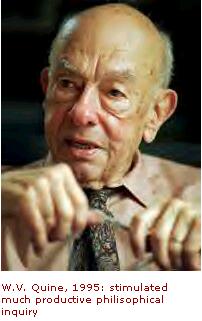
(UK) The Times obituary for W V Quine - Dec 30 2000
A powerful critic of much that other philosophers held dear, W. V. Quine had a career as teacher, author and thinker spanning seven decades. In the course of it he became the most famous and probably the most influential analytic philosopher of his time.
Willard Van Orman Quine was born in Akron, Ohio, where he spent the first 18 years of his life, and years later showed his affection for the city and the state by delighting in the song (from Leonard Bernstein's Wonderful Town) , "Why, oh why, oh why-oh, Did I ever leave Ohio?" His undergraduate years were spent at Oberlin, but for his graduate study (with A. N. Whitehead) he migrated to Harvard, which was his academic anchor ever after. Quine paid two visits to Oxford: in 1953-54 as Eastman Visiting Professor, and in 1973-74 as Savile Fellow of Merton College and Wolfson Lecturer. The first of these visits had a tremendous impact. At that time Oxford philosophers knew very little logic and were unaware of the subtlety of much contemporary American philosophy. By the time of the second visit, Quine's work was widely known in Oxford.
Quine's career was initially as a mathematical logician. His first five books were all devoted to logic. But he had no great pretensions about his achievements in this field; on his first visit to Oxford, he described himself as a member of the Second XI of logicians. He proved some interesting minor theorems, but no important ones. His principal contribution was the invention of the heterodox system of set theory known as NF, after the article of 1936, New Foundations for Mathematical Logic, in which he originally expounded it.
The system teased the logical community by the difficulty of finding a model for it, or of proving it consistent in any other way. It reflected an important facet of Quine's intellectual character, for it is an example of a mathematical theory conceived, most unusually, in a purely formalist spirit. Quine proposed it without even the vaguest conception of a model for it, that is, of the sort of mathematical structure in which its axioms would hold good. Rather, he simply had a hunch that a certain formal restriction on the assumptions embodied in it about which sets existed would suffice to guard against contradiction.
Quine never abandoned mathematical logic, but from 1953 onwards, with his collection of previously published essays From a Logical Point of View, he acquired a wide reputation as a leading philosopher of language in the analytic tradition. His initial motivation was a reaction against the doctrines of Rudolf Carnap, the influential former member of the Vienna Circle who had settled in the United States. Quine engaged in powerful criticism of basic doctrines of analytic philosophy, as it had developed out of logical positivism. In particular, he attacked a Kantian dichotomy which had become a basic tool of analytic philosophy, the distinction between analytic and synthetic statements: those whose truth rested solely on the linguistic conventions determining the meanings of the words used to express them, as against those conveying genuine information about the world. His attack was supported by other American analytic philosophers such as Morton White and Donald Davidson, but strongly resisted by the philosophical school then dominant in England and particularly at Oxford. The rejection of the analytic/synthetic distinction posed far-reaching threats to other cherished notions. If any pair of expressions had the same meaning, say "paternal grandfather" and "father's father", then a statement such as "Anyone's paternal grandfather is that person's father's father", asserting their equivalence, must be analytic. So, conversely, if no statement is unambiguously analytic, it can never be determinate that any two expressions have the same meaning. If, thus, the notion of synonymy crumbles, that of meaning itself is in jeopardy. With the assault upon the notion of meaning went an attack upon modality. Not only did Quine suspect modal logic, which deals with the operators "Possibly" and "Necessarily", of being pseudo-logic; he dismissed as incapable of clear explanation sentences of natural language containing modal verbs such as "can", "may" and "must". Not only was the necessity supposedly deriving wholly from the meanings of words to be repudiated: necessity of any kind was to be repudiated also.
Quine's status as the most respected philosopher in the United States was confirmed with the publication in 1960 of his magnum opus, Word and Object. The most celebrated thesis advanced in this book was the indeterminacy of translation. Two schemes for translating from one language to another might both satisfy all the constraints imposed by the empirically observable behaviour of the speakers of both languages upon an adequate translation scheme; and yet some sentence of the first language might translate under the first scheme into the contradictory of the sentence into which it translated under the second scheme.
This of course could not happen if the sentences of the two languages had determinate meanings and it were a requirement upon an adequate scheme for translating between them that it take a sentence of the one language into a sentence of the other with the same meaning; but Quine contended that no empirically observable facts about the speakers' linguistic and other behaviour determined any such meanings. Contentions such as these might suggest to those unfamiliar with his writings that Quine was some species of Post-Modernist. Nothing could be further from the truth. His writing was always crystal sharp; he never had the slightest doubt about the value of philosophy, nor did he call the concept of truth in question. Sir Michael Dummet vividly remembers Quine's disgust as they both listened to a talk in which Donald Davidson's philosophy was compared to that of Jacques Derrida.
Quine criticised ideas dear to earlier philosophers and apparently obvious to common sense, not in the interests of cultural relativism or any of the other fashionable varieties of relativism, but in the service of what he saw as a strictly scientific methodology, in fact of a behaviouristic methodology. Where Wittgenstein saw philosophy as an activity wholly unlike scientific enquiry, Quine saw it as ancillary to it and governed by the same canons: it was to his mind just a branch of science. He professed more than once a liking for desert landscapes, and his intellectual landscape was bare indeed: more accurately, bleak.
A commonsense diagnosis is that two factors combine to dispose us to accept as true any statement we do so accept: our grasp of its meaning, and our experience of the world. Quine maintained that these two factors can never be disentangled: we cannot distil out separately the contributions made to our judgments of truth by our knowledge of the language and by our experience of reality. This doctrine of inextricability was extended to a broader holism about language: we do not give to our sentences meanings which allow us to judge them individually as in accord with our experience or otherwise; we can judge as being or not being in accord with experience only the totality of all that we hold to be true. If we judge it not to accord with our experience, we need to revise our total set of beliefs one way or another; but it may be that there is more than one way in which to revise it so as to bring it into harmony with experience once more, where those two or more possible revisions are not equivalent by any standards.
With speculations of this kind, Quine crossed from the philosophy of language into the realm of epistemology, with which he came to occupy himself greatly. Epistemology, he claimed, should be naturalised; and, with this claim, Quine became responsible for a new fashion in philosophy, the so-called naturalisation of its theories. Though naturalised theories treat of certain questions traditionally posed by philosophers, the answers they give may invoke scientific facts and replace a priori speculation with empirical explanation. Quine retired in 1978 from a teaching career in which his pupils had included not only influential philosophers but also the satirical songwriter Tom Lehrer and Theodore J. Kaczynski, the so-called "Unabomber". He continued for two decades to do active work in philosophy, attending conferences and publishing papers. He must have collected far more prizes and honorary degrees than any other contemporary philosopher or than almost any other academic; but what he most rejoiced in collecting were the countries that he had visited. He was immensely vain about their number, and vain, too, about his ability to speak a number of languages. He liked etymology and unusual facts about words. His writing was distinguished by a feeling for words and an often witty use of them. His political opinions were on the Right, but he was tactful in not voicing them in the presence of people he knew to be of a different inclination.
Quine was an important philosopher, though posterity may not class him as a great one. He was important because he advanced bold theses for which he never produced proofs but only highly suggestive considerations: but they were theses which it was very difficult to refute, and he therefore stimulated a great deal of fruitful philosophical inquiry. Analytic philosophy in the second half of the 20th century would have been greatly the poorer without him. In 1930, just on arrival at Harvard, Willard Quine married Naomi Clayton, whom he had met at Oberlin. They had two daughters, in 1935 and 1937, but the marriage came to an end in 1945, when they separated. They divorced two years later. Then, in 1948, Quine married Marjorie Boynton, whom he had first known as a woman volunteer during his time as a Navy lieutenant in Washington during the war. She predeceased him in 1998. He is survived by two daughters from his first marriage and a son and daughter from his second. W. V. Quine, philosopher, was born in Akron, Ohio, on June 25, 1908. He died in Boston on Christmas Day aged 92.
Times article about W V Quine and philosophy - Jan 3 2001
When a philosopher dies there is one less star in Heaven. Or so we were once told. Philosophers guard the spyholes in the firmament. They are supposed to tell us of the Great Beyond. As the taxidriver asked Bertrand Russell: "So what's it all about then, Bert?"
Last Saturday, The Times carried an obituary of one of the most celebrated philosophers of our age, the American Willard Quine. I understood hardly a word of it. Quine's work was not a window on the Great Beyond but an intellectual microscope applied to games he played with others. He was, it seemed, another of Keats's dullards who "will clip an Angel's wings". If ever there were a philosopher's philosopher it was Quine. He prowled the frontiers of set theory and mathematical logic. In the 1950s he crossed swords with Viennese logical positivism and questioned the "Kantian dichotomy which had become a basic tool of analytical philosophy", between statements "whose truth rested solely on the linguistic conventions determining the meanings of words used to express them, as against those conveying genuine information about the world". This sort of distinction well demonstrates the distance philosophy had travelled from public accessibility. To be fair, Quine protested it as a naturalist who held that "physical facts are all the facts there are". Philosophy is no more or less than a science. Yet to what effect? I can think of economists and political theorists whose ideas have changed my life. I can think of engineers, inventors, jurists, even artists, who have upset the equilibrium of my days, not always for the better. But the philosopher wanders the scholastic desert alone, skirting any oasis where he might find beings who speak a common tongue. The heirs of Socrates and Aristotle, Erasmus and Hume wrestle with each other apart. Not surprisingly, Quine's obituarist said of him: "He professed a liking for desert landscapes, and his intellectual landscape was bare indeed, indeed bleak." Why then was Quine awarded more awards and honours "than any other contemporary philosopher or than almost any other academic"? What is it about philosophers that values them so highly? Perhaps we have dumbed so far down that we celebrate sheer abstruseness. Philosophers embody pure learning, pure irrelevance. We value them not as intellectual snobs but as ascetics, hermits defying the draconian quantification of David Blunkett's quality auditors. Yet showering philosophers with awards lets them off the hook.
There is work for them to do, urgent work that they seem to funk.
I doubt if public policy has ever had a longer agenda for them to tackle, problems that would have delighted a Locke or a John Stuart Mill. How far does our responsibility really extend to the poor? What should be the limits of redistributive taxation? What entitles us to interfere in the lives of strangers, or of foreign states? (Does whatever it is extend to bombing their cities without declaring war?) Does it extend to criminalising their governments for growing narcotic crops of which we disapprove? Does it extend to the unborn child? Crime and punishment at present suffer acute philosophy starvation. What right do we have to deprive of liberty teenagers whose misdeeds may be the result of our own or their parents' negligence? We hurl an unprecedented barrage of rules against individuals. We stop them bringing up children as they wish. We discriminate in favour of some groups at the expense of others. Is there no point at which this should stop? The philosophy of identity seems silent. The greatest threat to personal liberty no longer comes from the traditional enemies of war, poverty and disease. It comes from ever more intrusive organs of the State, the more insidious because often unintended and even denied. I am sure Tony Blair genuinely believes himself to be something called a liberal. Yet the boundaries to state action laid down by English philosophers in the 18th and 19th centuries are being overrun by stealth. Hayek and Popper warned against socialism's abuse of state power. Their socialism may have been laid to rest, but the extension of state power continues unabated. The presses thunder out ever more laws, filling prisons with those who break them. Each day a growing tide of buff falls through every letterbox. The Stuart Mills of today say nothing. The "death of ideology" seems to darken rather than brighten the gloom. Philosophers should hold up their tapers in this gloom.
What is the philosophy behind the present Court of Appeal's eagerness to monetarise every personal hurt and match compensation to every injury irrespective of fault? A sort of communism is being reborn in the guise of cradle-to-grave insurance. Is this fine? Nothing is discussed. Or take the conundrum of the rights of the family vis- -vis the State. Families are said to underpin social morality, supplanting religion in this respect. But why the family? Are familial rights not pagan, a reactionary genetic construct that stands in the way of equal opportunity and a fairer society? Appeals to kinship have caused social conflict from the Tribes of Israel through the Wars of the Roses to the ethnic upheavals of today. If the family is to "underpin" modern morality, some philosopher had better redefine it fast. What of the violent family, the family that wants to keep Siamese twins, or wants to eat beef-on-the-bone? As politicians talk gibberish, where are the philosophers calling them to account? Some have sought to engage these arguments. Bernard Williams has worked on theories of personal identity, Jonathan Glover on the concept of "life", Roger Scruton on aesthetics and sexual desire, John Rawls on justice and fairness. But they seem like aliens beating on the locked door of Babel. When John Prescott took power last year to imprison Britons for freeing budgerigars into the wild or building steps to their front doors, I realised that the debate over the rights of individuals versus the State had not advanced since Plato's day. A Renaissance prince would not have presumed such authority, nor any government before the 20th century. The dictatorship of liberty is the more odious since its major premises are left unspoken. We can play with human life in a test tube and throw over it the umbrella of liberalism. We can do the same with policy towards prisons. Government can tax and regulate in ways unimaginable to those who formed the British constitution in the ages of Revolution and Enlightenment. Political and economic innovation moves with the speed of light, yet is debated in terms of numbed vacuity. Read any political speech or read any political book. With the supposed death of ideology, they offer no recourse to theoretical concepts to help to resolve the natural conflicts that make up politics - just as fudged buzzwords of the "Third Way" or "One Nation". Fierce battles are about to be fought over refashioning the English countryside, battles over long and short-term costs and benefits, over the rights of newcomers over established residents. Philosophy should be shouting aloud about this. Is it? Britain's leaders may have studied philosopy at Oxford. But that school cannot be what it was. They have lost touch not just with the ideology of liberty but with the idea of ideology at all. They have lost faith in ideas as a guide to action. Lost in short-term self-interest, in the sovereignty of the opinion polls, they fall back on liberty's line of least resistance, and find it ceding ground to the advancing battalions of big government. The tyranny of Marx has given way to the tyranny of accountancy. I have no doubt that philosophers such as Quine enjoyed their mental calisthenics. But they fiddled while Rome burned. Their successors must rally to the colours. The linguistic analysts must deconstruct the new authoritarians. The moralists must expose the hypocrisies of "value politics". Epistemologists must reveal politicians' speech codes that appear devoid of meaning.
Philosophers of mind need constantly to exorcise renascent "ghosts in the machine". Nobody expects philosophers to agree, any more than do economists or political scientists. They merely need to make their voices heard. The philosopher should once more be what Nietzsche called the "terrible explosive, in the presence of which everything is in danger". He should dare to make the earth move.
Time Magazine obituary for W V Quine - Jan 8 2001

UselessKnowledge.com obituary for W V Quine - Dec 14, 2004
This Christmas Day, pause to revere a man who had no time for religion. His name was Willard Van Orman Quine, and he died four years ago on Christmas Day. He was many things: teacher, writer, mathematician, linguist, et al. Above all, he was the greatest philosopher America has yet produced. That alone deserves respect.
Why was Quine so good? The philosophical world Quine inherited was breaking up..... [full text at hot link]
Wall Street Journal obituary for W V Quine - Jan 4 2001
The death, on Christmas Day, of Willard Quine deprives America of its greatest contemporary philosopher. It also prompts us to reflect on the place of philosophy -- or at any rate of Quine's kind of philosophy -- in American culture.
Quine was a lucid writer, with a refined use of language and an ability to summarize difficult thoughts in entrancing aphorisms. He was also a metaphysician, with a view of the world as comprehensive, in its way, as that of Hegel. In almost all areas of logic, metaphysics and the philosophy of science, there is a distinctive "Quinean" position -- a position so fortified by the internal coherence of the system as to be virtually unassailable from outside. This ought to make Quine one of the most widely read and pondered of American philosophers. In fact the discussion of his views is now largely confined to the professional journals.
One reason for this comparative neglect is that Quine had no social or political agenda. His was an honest, logical philosophy, and his theories, however radical, eschew all moral exhortations. He was profoundly influenced by the pragmatism of C.S. Peirce, which sees truth as a species of utility and scientific method as the route to it. But Quine's pragmatism, like that of Peirce, stands at one remove from all first-order disputes, and recognizes no avenue to knowledge apart from scientific method. That Quine also cast serious doubt on the absolute claims of science in no way tells against his view that it is science, not philosophy, that answers our first-order questions.
That is one reason why Quine is worth reading. He belonged to the intellectual tradition which included Gottlob Frege, Bertrand Russell, Rudolf Carnap, Kurt Godel and Alfred Tarski, and which was, collectively, one of the outstanding achievements of modern philosophy. Like his predecessors, Quine saw philosophy as an extension of logic -- a realm of pure enquiry, concerned to clean up the tools with which we reason and to wipe away the shadows cast by words. In face of the pretentious theories of Being with a capital "B" -- with which the phenomenologists enrolled their congregations -- Quine's robust insistence that "to be is to be the value of a variable" had a cheekily iconoclastic air.
Yet behind that simple remark lies a whole philosophy, remarkable for its range, its consistency, and its comprehensive vision of human knowledge. Central to this philosophy was the thesis of "ontological relativity," which holds that all tenable statements about existence depend upon a theory, and no theory is uniquely determined by the empirical data. Hence you and I can live in the same empirical world, even though mine is haunted by gods, and yours by electromagnetic waves.
Quine was a philosophical, but not a political, iconoclast, and he would surely have been appalled by the recent attempts to make philosophy socially and politically "relevant." The suggestion that pragmatism might provide a philosophical vindication of radical politics would have gone against the grain both emotionally and intellectually. In this he was a far cry from those philosophers who now have an audience among the general reading public -- and notably from Richard Rorty, who makes striking and (in my view) outrageous claims, linking the pragmatist tradition to fashionable "liberationist" causes.
I never knew Quine. But I am sure that he would have regarded Mr. Rorty's feminist pragmatism as an intellectual betrayal -- not because Quine was a conservative (though he was), but because agenda-mongering is incompatible with the purity of philosophical argument, as he conceived it. It is for this reason that no one would be able to guess, from reading his "Word and Object" or "From a Logical Point of View," that Quine was a political conservative.
Outside departments of philosophy it is difficult to advance in the American academy without showing one's political colors, and they must be the right (which is to say left) ones. Thinkers like Richard Rorty, Jacques Derrida and Peter Singer, each of whom has swept to eminence on the crest of some political wave, are known to all students of the humanities, and to the reading public at large. They are the salesmen of philosophy to the non-philosophical, but none of them compares, for rigor, depth or truthfulness, with Quine. Intellectually and stylistically he occupies a pinnacle far above their clouds of murky rhetoric, and it is sad to reflect that only students of philosophy today have any inkling of this.
Nevertheless, thanks in part to Quine's influence, philosophy remains one of the glories of the American academy. His extraordinary combination of intellectual austerity and metaphysical boldness set the example that Donald Davidson, Hilary Putnam, Saul Kripke and others have followed. If the general public knows nothing of those philosophers it is not because they are narrow specialists with no feel for the larger issues. It is because, like Quine, they have upheld the dignity of philosophy, as a discipline in which truth, not relevance, is the goal.
Washington Post obituary for W V Quine - Dec 31 2000
Willard Van Orman Quine, 92, for decades one of the luminaries of the American academic world, a philosopher who did his thinking about thought itself, died on Christmas Day in Boston, where he lived. The cause of death was not reported.
Dr. Quine taught at Harvard University for more than 40 years, publishing more than 20 books and winning a reputation as one of the foremost figures in American philosophy, as a specialist in mathematical logic and in the meaning of language.
Although perhaps little known to the public, Dr. Quine, with his more than 150 scholarly articles, took a vigorous hand in the struggles that roiled his discipline, and continued to be active long after his formal retirement in 1978. He was widely read in college courses and was renowned for his penetrating criticism of some established doctrines. He was a man of mathematical precision, logical exactitude and formidable mental stamina. He lived on Boston's Beacon Hill, rode the subway to his office in Cambridge, and dealt with questions that might trouble any of his fellow passengers in some way at some time, but that few of them could deal with at such intellectual depth. His life's work was to find answers to questions such as these: What do we Know? Can we Know? How do we know that we Know? What things do we take for granted in trying to know -- and how does the language we use determine how we think and how we view the world? What occupied him, he said, was this: "How is it possible that we, on the basis of just the triggering of our sense receptors, have developed this elaborate theory about the world all the way out to the distant constellations and down to the imperceptibly small?"
Dr. Quine was known for expressing himself in a way that often sliced through academic verbiage. "The lore of our fathers is a fabric of sentences," he once wrote. "A pale gray lore, black with fact and white with convention."
Among philosophers, Dr. Quine was known in particular for his effort to wipe out what was once thought to be an important distinction between varieties of truth. One type was said to be analytic, the other synthetic. Dubbed analytic were statements that seemed innately, inherently, linguistically true. Those dubbed synthetic were statements considered true because they reflected the way things are. Some philosophers viewed this distinction as a boundary between two distinct kinds of knowledge. One kind was knowledge that could be deduced by reason. The other was knowledge that could be obtained empirically, through experience.
In one of the works for which he was best known, "Two Dogmas of Empiricism," published in 1951, Dr. Quine argued against the validity of this distinction. Perhaps an even more influential book was "Word and Object," which he published in 1960. It elaborated on his idea that how people talk about the external world determines how they see it. "The idea of reducing the unfamiliar to the familiar -- that's what we have in science," he once said. Dr. Quine was born in Akron, Ohio, studied mathematics at Oberlin College, and earned a philosophy doctorate at Harvard.
Although he was hired at Harvard to teach philosophy, he said, he was strongly attracted to mathematics "because of it being less a matter of opinion. Clarifying, not defending. Resting on proof." He taught mathematical logic and set theory, and a course on logic in philosophy. During World War II he was a Navy officer, helping to decipher communication codes used by German submarines. It turned out that one of those who had taken one of his classes was Theodore J. Kaczynski, who was convicted in the Unabomber case.
"Just the other day," a Boston area newspaper quoted him in 1996, "I took out my old records. I did teach Kaczynski, although I don't remember him. He tied for top, 98.9 percent." In addition to important figures in the world of academic philosophy, his students also included Tom Lehrer, the song satirist. Set theory, in which Dr. Quine worked, could be used in analyzing philosophical propositions, and as an underpinning for the functioning of computers.
ears ago, he told a reporter that "I'm pretty sure I'm not interested in computers." He said that he was "only interested in theory. Not its application." His marriage to Naomi Clayton ended in divorce. He married his second wife, Marjorie Boynton, in 1948. She died in 1998. Survivors include two children from his first marriage and two from his second.
Die Zeit obituary for W V Quine - Jan. 3 2001
Willard Van Orman Quine hat keine singul re These in die Welt gesetzt, aus der sich simple Ableitungen hervorzaubern lassen. Vielmehr hat er in den zentralen Bereichen der theoretischen Philosophie - von der modernen Logik ber die Erkenntnistheorie und die Sprachphilosophie - derart gewaltige Meilensteine hinterlassen, dass er noch zu Lebenzeiten als Klassiker der Philosophie gehandelt wurde. Sein Einfluss auf den amerikanischen Neopragmatismus, der sich um die Namen Hilary Putnam und Richard Rorty, aber auch Nelson Goodman und Donald Davidson rankt, ist unbestreitbar.
Die Beitr ge zur Analytischen Philosophie waren bahnbrechend. Keine Seite konnte Quine f r sich vereinnahmen. berhaupt ist der Logiker Quine reflektiert genug gewesen, der "s en Simplizit t der zweiwertigen Logik" skeptisch gegen berzustehen: F r ihn muss ein Satz keineswegs entweder wahr oder falsch sein, weil es keinen externen Ma stab gibt, der als "tertium quid" dar ber befinden k nnte. Vielmehr konnte es f r Quine berhaupt kein Kriterium geben, das als Richtschnur ber Wahrheit oder Falschheit empirischer Theorien entscheiden k nnte. Wie schon bei Kant lassen sich nur Vorstellungen mit Vorstellungen, S tze mit S tzen, Theorien mit Theorien vergleichen. Ein subjektunabh ngiger Standpunkt, eine perspektivenfreie Neutralit t ist niemals in Sicht. In welcher auch?
Die Wissenschaften sind eine "Begriffsbr cke"
Was immer wir in unseren Blick r cken, es sind hochgradig theoriebeladene Kontexte: Die Natur, die Realit t oder die Wirklichkeit selbst, sozusagen nackt und unbefleckt, neutral oder unschuldig, steht uns nicht zur Verf gung; eine Entsprechung von Sachverhalt und Theorie gibt es nur innerhalb von Theorien. Deshalb konnte Quine sagen, "das System der Wissenschaft mit seiner Ontologie" sei eine "von uns selbst gebaute Begriffsbr cke". Die so genannten Tatsachen, die angeblichen "harten Fakten", sind allesamt Tat-Sachen; sie sind, viel w rtlicher, als einem lieb sein kann, nur Sachen der Tat, womit zumindest der artifizielle Charakter der Wissenschaft, ihr ontologischer Relativismus, in Erinnerung gerufen wird. Dass hierbei Kant und Nietzsche, aber auch Hegel Pate stehen, beginnt sich in der amerikanischen Philosophie nach Quine herumzusprechen. Rorty schl gt diese Br cke ber den Atlantik mit seinen Hinweisen auf Dewey und l dt dazu ein, Quine nicht nur mit Sellars, sondern auch mit Heidegger und Gadamer zu verbinden.
F r Quine selbst, der 1908 in Akron (Ohio) geboren wurde und in Harvard Mathematik und Philosophie studiert sowie bei Whitehead promoviert hat, lagen die fr hen Wurzeln seines Denkens im Umfeld der Theorien von Bertrand Russell, danach von Rudolf Carnap und Alfred Tarski, die er w hrend eines Europa-Aufenthaltes in Prag und Warschau kennen gelernt hat. Dieser Zugang zur Philosophie l sst sich bis in sein Sp twerk verfolgen. Insbesondere seine Ber hrung mit dem logischen Positivismus des Wiener Kreises hat ihn zu einer kritischen Einsch tzung des metaphysischen Empirismus veranlasst und seither dazu bewogen, den von ihm analysierten "Dogmen des Empirismus" eine konstruktive Alternative zu etablieren. Waren da zun chst noch die Auseinandersetzungen mit Fragen zur Logik und Mathematik, die sich in den drei iger und vierziger Jahren unter anderem in Texten wie A System of Logic (1934) oder Mathematical Logic (1940) sowie Elementary Logic (1941) niedergeschlagen haben, kam es Anfang der f nfziger Jahre - nach einem dreij hrigen kriegsbedingten Intermezzo bei der US-Navy - zum ersten gro en Wurf, der ihn als Harvard-Philosoph ber Amerika hinaus ber hmt gemacht hat. Two Dogmas of Empiricism (1951) und From A Logical Point of View (1953) waren neben vielen anderen Schriften die Ausgangspunkte f r Quines Besch ftigung mit der Sprachphilosophie und der Ontologie, die dann in Word and Object (1960) in einem koh renten empiristischen Gesamtentwurf mit provozierenden Stellungnahmen einm nden.
Wie in allen gro en denkerischen Leistungen finden sich bei Quine vorwiegend Fragestellungen, die zur Reflexion anregen, und keine fertigen Wahrheiten, die sich in die Welt hinausposaunen lassen. Sein letztes Werk tr gt die berschrift Unterwegs zur Wahrheit, was an Lessings ber hmte Formel erinnert, derzufolge die "Wahrheit keine M nze" w re, sondern ungem nzt bleiben muss, um sich bedarfsgerecht umm nzen zu lassen oder "Wert einer Variablen" zu bleiben. Zugleich erinnert uns dies an Nietzsche, f r den es aufgrund unserer Schematisierungen keine Wahrheit gibt: "Es gibt keine Wahrheit", sogar "um der Wahrheit willen", und "der Werth f r das Leben entscheidet zuletzt".
Die Suche nach ewiger Wahrheit ist fruchtlos
Und doch war f r Quine die Wahrheit ein heuristisches Ideal; sie bleibt zu sich selbst unterwegs, weil ihr der Zugang zu einer externen Realit t, die ihre jeweiligen Bedingungen und Voraussetzungen berschreiten k nnte, verwehrt ist. Darum nannte Quine "die Wissenschaft nichts weiter als eine h chst ausgefeilte Form des gesunden Menschenverstandes", der an "unterschiedlichen Stellen in unterschiedlichem Ma e fehlbar ist". Die Wissenschaft "kann jederzeit einmal berichtigt werden m ssen, doch bietet sich uns eben schlicht und einfach keine andere Zugangsm glichkeit zur Wahrheit".
Welche Gegenst nde f r die Wissenschaft relevant sein k nnen, entscheidet sich jedoch nicht unabh ngig vom historischen, pragmatischen und kulturellen Zusammenhang, innerhalb dessen eine Bestimmtheit aus dem "Sperrfeuer sinnlicher Reize" isoliert wird. Deshalb kann es f r Quine auch keine neutralen Fakten geben, die dem Relationengeflecht von Empirie, Sprache und Theorie entzogen w ren. Was immer uns erscheint, erscheint uns bereits interpretiert als etwas, das sich unserer eigenen Zur stung und Einteilung durch zweckm ige Auswahl, Abgrenzung und Isolation verdankt. Die Suche nach ewigen Wahrheiten, nach einer gesicherten Erkenntnisbasis oder nach letzten Begr ndungen au erhalb unserer eigenen Welterzeugungen ist fruchtlos.
Die philosophische Wahrheitssuche ist f r Quine keineswegs obsolet - doch sie findet nur innerhalb von Beschreibungssystemen statt. Das hei t: Die metaphysische Wende, die sich alle gro en Philosophen zugute halten, besteht darin, dass die jeweils erreichte und wirksame Wahrheit ihre ganze Realit t ausmacht, jedenfalls solange sie sich auf ein reflexiv einholbares Wissen st tzt. Dann verwandelt sich eine naive Wahrheit in eine philosophische Weisheit; immanente Relevanz ersetzt transzendente Realit t, und die Objekte der Wissenschaft verh rten sich zu kulturellen Erfindungen, die wir um ihrer Plausibilit t willen aus der metaphorischen Wirklichkeit in eine begriffliche Realit t projizieren. So glauben wir an einen Fortschritt, der von Homer bis Einstein stattgefunden hat oder stattgefunden haben k nnte. "Was mich angeht", schrieb Quine schon 1951, "glaube ich ... an physikalische Objekte und nicht an die G tter Homers ... Doch hinsichtlich ihrer epistemologischen Fundierung unterscheiden sich physikalische Objekte und Homers G tter nur graduell und nicht prinzipiell. Beide Arten Entit ten kommen nur aus kulturellen Setzungen in unser Denken. Der Mythos der physikalischen Objekte ist epistemologisch den meisten anderen darin berlegen, dass er sich darin wirksamer als andere Mythen erwiesen hat, dem Fluss der Erfahrungen eine handliche Struktur aufzupr gen."
F r Quine gab es immer "mehr als nur eine angemessene M glichkeit, sich die Welt zu denken". Die Welt besteht eben aus verschiedenen Kontexten, und auch in diesen artikuliert sich eine Plausibilit t, die sich "unterwegs zur Wahrheit" befindet. Dabei geht es nicht um ein "endg ltiges Richtig oder Falsch", sondern "eher um ein Besser oder Schlechter", womit sich das Wahrheitskriterium in ein Meliorationskriterium verschiebt. Das mag eingefleischten Wahrheitsfanatikern als erb rmlich wenig erscheinen. Aber mehr als Plausibilit t im Kontext der Kultur zu erwarten, hie e, jene massiven Dogmen zu vertreten, die Quine erfolgreich verabschiedet hat.
Am ersten Weihnachtsfeiertag ist Quine im Alter von 92 Jahren in Boston verstorben.
Search Web Site Pages
- Find books at Amazon.com by 10 character ISBN (i.e. 0262670046) - or at the web site
![[E-Mail Cartoon]](http://www.wvquine.org/toone048.gif)
Return to top
Feedback
- View W. V. Quine guest book volume 1
- View W. V. Quine guest book volume 2
- View W. V. Quine guest book volume 3
- View latest W. V. Quine guest book
- Sign into (email) the guestbook: to post your comments or questions
- View Douglas Boynton Quine guest book
- View Boynton Family guest book
- View Quine Family guest book
- E-mail the webmaster:
- View Privacy Statement
Your visit makes more than 5,477 visitors (counters stopped working in Nov. 2017) to this web page. This page was created on December 23, 2003 and updated July 9, 2026). Copyright (c) 2003-2026 by Douglas B. Quine.