Willard Van Orman Quine
1908-2000
Philosopher and Mathematician
WVQ home (this page)
- Awards
- Book reviews (popular) by WVQ
- Book reviews (prof.) by WVQ
- Computer "quine"
- Degrees: earned & honorary
- Dictionary references to WVQ
- Dictionary reviews by WVQ
- Family genealogy
- Feedback
- Fiction by WVQ
- Guest books
- Home addresses
- Humor about WVQ
- Home Page for WVQ (here)
- Mass media references
- Advertising
- Books - non-fiction
- Books - novels
- Cartoons
- Computer programs
- Game shows
- Musical tributes
- Newspapers
- Philately / Stamps
- Poems / Limericks
- Portraits
- Postmarks
- Toys
- Word Games
- Missing papers / citations
- News of WVQ
- Offices held
- Patent references
- Popular (media) references
- Prizes
- Pronunciation of Quine
- "quine" computer program
- Quine family genealogy
- Quine in (and on) dictionaries
- Quotation Collections
- Quotation Queries
- Residences
- Reviews (popular) by WVQ
- Reviews of WVQ's books
- Search WVQ web site
- Students: Ph.D. listing
- Students: undergradute
- Web page review
WVQ Web Site Map
More WVQ Web Content by DBQ
- About WVQ
- Art by WVQ
- Articles by WVQ
- Audio recordings
- Avocations of WVQ
- Book reviews (prof.) by WVQ
- Books by WVQ
- Book Corrections
- Books on WVQ (partial)
- Collected works by WVQ
- Collection: Philosophy of Quine
- Collection: Quintessence
- Conferences on Quine (partial)
- Courses on Quine (partial)
- Dissertations on WVQ (partial)
- Drawings by WVQ
- Essays by WVQ
- Guestbook WVQ vol. 1
- Guestbook WVQ vol. 2
- Guestbook WVQ vol. 3
- Guestbook WVQ vol. 4
- Hobbies of WVQ
- Home Page for WVQ (here)
- Interviews
- Lectures delivered
- Lectures unpublished
- Manuscripts unpublished
- Memorials
- Memorial symposia listing
- Musical Tributes to WVQ
- Newspaper - biography
- Newspaper - Kyoto prize
- Obituaries 1 (A-F, photographs)
- Obituaries 2 (G-P)
- Obituaries 3 (Q-Z)
- Obituaries 4 (talks 1)
- Obituaries 5 (talks 2)
- Paintings by WVQ
- Photographs of WVQ 10 decades
- Photography by WVQ
- Published Interviews
- Quotes about WVQ
- Reviews (professional) by WVQ
- Seminars on Quine (partial)
- Site Map of WVQ Web Site
- Songs About WVQ
- Stamp newsletter by WVQ
- Symposia listing
- Translations of WVQ books
- Travels
- Videotape Interviews
- Web sites by others
- Web sites - obsolete
DBQ Family Web Sites
- Quine Ancestors
- Quine Family Tree
- Paine Ancestors
- Boynton Ancestors
- Boynton Family Tree
- (this page WVQ)
- Marjorie Boynton Quine
- Douglas Boynton Quine
- Victoria Quine (web site)
- Robert Quine
- Blank Page (TPILB project)
 Home page for Willard Van Orman Quine, mathematician and philosopher who held the Edgar Pierce Chair of Philosophy at Harvard University from 1956-2000. Over the last half century his literary output was prodigious in such areas as mathematical logic, set theory, the philosophy of language, and the philosophy of logic. His best known works include "The Ways of Paradox", "Mathematical Logic", "Set Theory and Its Logic", "Quiddities", and his most influential "Word and Object". His style is not only eminently lucid but lively and elegant. Professor Quine was born June 25, 1908 (exactly half a year away from Christmason "anti-Christmas") and died December 25, 2000 (Christmas). His ashes rest beside his parents' remains in the Glendale Cemetery, Akron, Ohio with portions scattered in Cambridge MA, Harvard MA, and Meriden CT (with his wife, Marjorie). The last paper he presented was Three Networks: Similarity, Implication, and Membership in Boston (August 1998); it was published in Proceedings of the Twentieth World Congress of Philosophy (#6).
"Quine has made many contributions to logic, but in his philosophical writings he focuses on meaning and existence - the age old concerns of philosopher-man - and he thus continues the traditions begun by the ancient Greeks. Because he is America's most influential living philosopher, many of his concerns have become major concerns of his contemporaries." [from Essays on the Philosophy of W. V. Quine R.W. Shahan and C. Swoyer, editors, University of Oklahoma Press, 1979]
 Extensive visitor comments regarding his philosophy may be read in the W. V. Quine guest book and you may sign into (email) the guestbook:
 ![[guestbook]](https://www.wvquine.org/guest-link.gif) to post your comments
or questions. This page is maintained by Douglas Boynton Quine; please E-Mail recommended additions, or corrections to the webmaster:
to post your comments
or questions. This page is maintained by Douglas Boynton Quine; please E-Mail recommended additions, or corrections to the webmaster: ![[webmaster]](https://www.wvquine.org/webmaster-link.gif)
Quine 2026 News
- David Marans' Logic Gallery captures 2,500 years of logic through images, wonderful quotations, and thumbnail biographies including a page on Quine. After countless updates, the current 205 page free Open Access PDF Logic Gallery.
- Douglas Quine added the remaining 30 boxes of W. V. Quine papers: additional 2020 Inventory to the 124 boxes of documents previously donated to the library (see below) by W. V. Quine and his family. The full descriptive table of contents and inventory of new material runs 85 printed pages and includes:
- WVQ Nearly complete set of published articles 1932-present (boxes 125-126)
- WVQ Occasional Lectures, Harvard Courses, and Grades; Dissertations, Orals (boxes 127-128)
- WVQ Youth Business Papers, Youth Maps / Writings, Scrapbook, Records, Datebooks 1920-1999 (box 129)
- WVQ Photographs 4,150 color slides complete travels and family individually identified 1947-1979, high resolution scanned images on DVD, and list of identified people compiled by Douglas Quine (boxes 130-135)
- WVQ Awards, Diplomas, Oral History, Sketch books, Portraits, Notebooks, Mementoes (box 136)
- WVQ Book Manuscripts and Proofs 1934-1987 (boxes 137-138)
- WVQ Quine family correspondence including continuous correspondence with parents starting in 1924 (boxes 139-142)
- CR Quine collected articles about Akron, Ohio history (box 140)
- WVQ Scans of 1,225 selected documents (box 131)

- WVQ Ohio Highway Marker documentation package and WVQ website printout and Fara Video study guide(box 140)
- WVQ autobiographical, college papers, frivia, interviews, unpublished (box 143)
- WVQ college course notebooks, reviews of WVQ books, travel (boxes 144-145)
- WVQ lecture scripts, Cassidys and Haskell extensive correspondence (box 145)
- WVQ special event souvenirs, autobiographical (box 146)
- WVQ commercial and social correspondence; divorce (boxes 146-148)
- WVQ obituaries, condolences, late correspondence, Navy, honorary degrees, publishers, travel (box 149)
- WVQ authored books with corrections and notes for revised editions (box 150)
- WVQ photograph folders and scrapbook (box 151)
- WVQ 1927 Remington typewriter (box 152)
- WVQ videotaped interviews (box 153)
- WVQ 4"x6" verbatim lecture notecards (box 153)
- WVQ miscellaneous travel, high school, college items (box 153)
- WVQ 3"x5" about 2,500 identified verbatim lecture notecards (oversize box 154)
- WVQ Kyoto prize photo album with captions (oversize box 154)
- WVQ autobiography original art, large childhood drawings, large diplomas (oversize box 154)
- The Houghton Library of Harvard University has an extensive W. V. Quine papers: Guide" to the 121 boxes of documents donated to the library by Quine and his family. If necessary, this website has a (local copy captured August 22, 2015). The full descriptive table of contents runs 147 printed pages and is organized into the following categories
 :
:
      I. General correspondence with Quine
      II. Other correspondence with Quine
            A. Correspondence concerning requests for permission to publish or for copies
            B. Invitations to lecture, declined
            C. Invitations to referee or serve on board, declined
            D. Invitations to write, declined
            E. Crank letters sent to Quine
            F. Editorial correspondence with publishers and editors
            G. Recommendations [Restricted until 2068]
       III. Compositions by others
       IV. Compositions by Quine
            A. Articles and other short texts
            B. Books and other long texts
            C. Occasional lectures
            D. Harvard lectures and other teaching materials
            E. Abortive writings and miscellaneous notes
            F. Computer floppy disks
            G. Unidentified compositions by Quine
       V. Quine student papers
            A. Oberlin College
            B. Harvard University
            C. Miscellaneous early papers
       VI. Biographical materials
       VII. Card files
            A. 3 x 5 inch card files: Harvard University lectures / Other note cards
            B. 4 x 6 inch card files: Harvard University lectures / Other note cards
- Search Web Site Pages
The W. V. Quine search engine finds obscure information within this 45 page website including the Harvard University Houghton Library guide. Just enter the text of interest in the search box and click on "Find!".
Quine 2024 News
- The National Academy of Sciences has just published a wonderful Willard Van Orman Quine 1908-2000 - A Biographical Memoir by Dagfinn Føllesdal and Andreas Føllesdal - March 29, 2024.
Quine 2021 News
- On May 15, 2021, Prof. Marcus Rossberg provided a much appreciated copy (PDF version at the hyperlink) of the long missing published version of Quine, W.V. 1979. Clauses and classes in Bulletin d'Information, Societe Francaise de Logique, Methodologie et Philosophie des Sciences 6: 23-39 [In response to a request dating back nearly 25 years, Prof. Marcus Rossberg reached out to his French colleagues and with the help of Prof. Marco Panza, Prof. Paul Égré, and Prof. Philippe de Rouilhan located a copy in Prof. de Rouilhan's private library in May 2021. The final citation in Quine's paper is handwritten in Quine's handwriting.].
- An international seminar was held August 3-6, 2021 in Brazil with 9 speakers on 60 Years of Quine's Word and Object.
Quine 2020 News
- On Dec. 10, 2020, Prof. Marcus Rossberg provided a much appreciated copy (PDF version at the hyperlink) of the long missing published version of Quine, W.V. 1988. Meaning, truth, and reference in Les Formes actuelles du vrai, pp. 51-61 ed., Nicola Incardona (Paris: Institut International de Philosophie).

Quine 2019 News
- Published in March 2019 and edited by Robert Sinclair: In this book, W. V. Quine's Science and Sensibilia: The 1980 Immanuel Kant Lectures (History of Analytic Philosophy) Book details, price, and availability from Amazon.com are published for the first time in English. These lectures represent an important stage in the development of Quine's later thought, where he is more explicit about the importance of physicalist constraints in his account of the steps from sensory stimulation to scientific theory, and in further using them to assess the extent to which mental vocabulary is defensible. Taken as a unit, these lectures fill an important gap in our understanding of his philosophical development from his 1973 work The Roots of Reference to his later work. The volume further contains an introduction that outlines the content and philosophical significance of the lectures. In addition, several essays written by leading scholars of Quine's philosophy provide further insight into the important issues raised in the lectures.
 Working from Within: Nature and Development of Quine's Naturalism by Sander Verhaegh. The book offers a novel interpretation of Quine's naturalism and a reconstruction of his early development based on a study of the W. V. Quine Papers at Houghton Library. Moreover, the book includes transcriptions of five previously unpublished papers, letters, and notes that shed new light on Quine's philosophical development.
Quine 2017 News
- Although internationally acclaimed, Quine maintained an open door and welcomed the students who ventured to his office. Professor Gastón de los Reyes, Jr. of The George Washington University School of Business recently shared this handwritten letter (full size). He received the letter in 1994 as a Harvard student who interviewed Quine for an article in the Harvard Crimson on Harvard's unique Society of Fellows. The letter illustrates the interest Quine still maintained in his visitors at the age of 85.
- Corrections have been posted for Mathematical Logic, Time of My Life, Confessions of a Confirmed Extensionalist, and Quine in Dialogue.
Quine 2016 News
- Over the summer, Harvard University undergraduate Tez Clark analyzed the editorial changes as Epistemiology Naturalized moved from draft manuscript to final publication (https://www.emiliehardman.com/epistemologynaturalized.xml is no longer accessible in February 2025).
Quine 2015 News
- Workshop on Quine's Philosophy: On Thursday November 19, the Faculty of Philosophy of the University of Groningen hosted a workshop on Quine's philosophy. The workshop (Oude Boteringestraat 34, room 112) was followed by the public defense (Broerstraat 5, Aula) of Sander Verhaegh's dissertation Rafts, Boats, and Cruise Ships: Naturalism and Holism in Quine's Philosophy. Everyone is cordially invited to attend the workshop, the public defense, and the reception. If you wished to attend the workshop, registration was required before November 15 by contacting Sander Verhaegh (A.A.Verhaegh[at]rug.nl)

09.45-10.45: Lieven Decock, VU University Amsterdam: Quine's 'strictly vegetarian' analyticity 10.45-11.45: Gary Ebbs, Indiana University Bloomington: Reading Quine's claim that definitional abbreviations create synonymies 12.00-13.00: Hans-Johann Glock, University of Zurich: The analytic/synthetic distinction: rise, fall and (willy-nilly) rehabilitation 16.15-17.15: Sander Verhaegh: Public defense 17.15-18.30: Reception - Published in November 2015: Quine and His Place in History includes papers presented at the international conference on Quine and His Place in History, University of Glasgow, Scotland December 16, 2014 to December 18, 2014. It contains three previously unpublished posthumous papers by W.V. Quine: his 1972 address to the Congress on Unified Science which was thought to have been lost, and two short papers developing his Pursuit of Truth position in response to Ebbs' review and revealing the usually covert influence of Dreben. It further contains eight historical, exegetical, and critical papers by Quine scholars from across the world: Ben-Menahem on pragmatism, Ebbs on analyticity, Hylton on philosophy of language, Janssen-Lauret on meta-ontology, Kemp on realism, Lugg on Quine and Wittgenstein, Sinclair on Quine and C.I. Lewis, and Lodge, Leary, and D. Quine on W.V. Quine and the Unity of Science movement.
Quine 2014 News
- 2014 International Conference: Quine and His Place in History, University of Glasgow, Scotland December 16, 2014 to December 18, 2014 included [full program]:
- Quine, D. B. "The Roots of Quine - Mortui Vivos Docent: Learning from and Exploring the Quine Archives" illustrated, audio, video PowerPoint presentation
- Quine, W. V. 1972. "Levels of Abstraction" (D. Quine, editorial update) originally presented at First International Conference on Unified Science, New York but never published [10 page typewritten manuscript preserved by Dr. Rolfe Leary]
- Lodge, A; Leary, R, Quine, D. 2014. "Observations on the Contribution of WVQ to Unified Science Theory"
- Post-Doctoral Research Position in Ontology After Quine at University of Hamburg (more details)
![[Ontology After Quine PostDoc Announcement]](https://www.wvquine.org/14-wvq-2014-12-11-postdoctoral-research-position 384x153.jpg)
![[Leif Parsons illustration of W. V. Quine]](https://www.wvquine.org/pr-26130-wvq-is-philosophy-literature-nyt-2012-06-30-leif-parsons-illustration.jpg) Quine 2013 News
Quine 2013 News
- 2013 International Conference: Quine, Logic and Philosophy, Peking University, Beijing, China July 26, 2013 to July 28, 2013 ... Conference Program
Quine 2012 News
- Is Philosophy Literature? by Jim Holt argues that contrary to popular expectations, there is some fine literature written by philosophers. His blog in The Stone forum for contemporary philosophers on issues both timely and timeless appeared in the New York Times on June 30, 2012. Leif Parsons' wonderful accompanying illustration (right) shows two readers at the beach reading "Quine".
- The special Issue of Disputatio Vol. IV, no. 32 (May 2012): New Perspectives on Quine's Word and Object is now available for open access on-line. It includes papers from the International Colloquium on Word and Object, 50 Years Later, which took place in Rome on May 28-29, 2010.
- Introduction (Francesca Ervas and Vera Tripodi, editors)
- Naturalizing Mathematics: A Critical Look at the Quine-Maddy Debate (Marianna Antonutti Marfori)
- Indispensability Arguments and Their Quinean Heritage (Jacob Busch and Andrea Sereni)
- All the Existences that There Are (Alberto Voltolini)
- The Indeterminacy of Translation: Fifty Years Later (Stephen White)
- Quine and the Contemporary Debate on Misreading (Giancarlo Zanet)
![[partiallyexaminedlife cartoon of W. V. Quine]](https://www.wvquine.org/12-wvq-2012-11-27-partiallyexaminedlife-com-cartoon-Quine-118x150.jpg) Episode 66 Quine on linguistic meaning and science A free ranging partiallyexaminedlife.com blog discussion on W.V.O. Quine's "On What There Is" (1948) and "Two Dogmas of Empiricism" (1951) hosted by Mark Linsenmayer.
Episode 66 Quine on linguistic meaning and science A free ranging partiallyexaminedlife.com blog discussion on W.V.O. Quine's "On What There Is" (1948) and "Two Dogmas of Empiricism" (1951) hosted by Mark Linsenmayer.
Quine 2011 News
 American Philosophical Quarterly and Quine: The July 2011 issue of American Philosophical Quarterly features articles on the life and work of American philosopher W.V. Quine. Among the contributors is former Quine student and co-founder of the Center for Cognitive Studies, Daniel Dennett. The contents list for APQ 48.3:
- Charles Parsons: Quine's Nominalism
- Delia Graff Fara: Socratizing
- Gerald J. Massey: Quine and Duhem on Holistic Hypothesis Testing
- Catherine Z. Elgin: The Legacy of "Two Dogmas"
- Dagfinn Føllesdal: Developments in Quine's Behaviorism
- Gilbert Harman: Quine's Semantic Relativity
- Thomas Ricketts: Roots of Ontological Relativity
- Alexander George: Quine's Legacy
- Daniel Dennett: Quine in My Life
- 20th Century American Philosophy Quine and Davidson:
A NEH Summer Seminar For College and University Teachers And Advanced Graduate Students
Prof. Gilbert Harman and Prof. Ernie Lepore, coordinators, June 20 - July 29, 2011, Princeton University (sponsored by the National Endowment for the Humanities). Dr. Douglas Quine was a guest speaker on June 29 and June 30.
- On March 15, 2011, Harvard University announced that Associate Professor of Philosophy Robert Sinclair, Brooklyn College, City University of New York has been awarded a 2011-2012 Houghton Visiting Fellowship to study "The Development of Quine's Philosophy" through a Rodney G. Dennis Fellowship in the Study of Manuscripts
Quine 2010 News
 "Word and Object" 50 years later: Colloquium in Celebration of W.V.O. Quine:
- The young researchers' group APhEx (Analytical and Philosophical
Explanation) has organized an international conference on W.V. Quine at the University of Rome "La Sapienza":
"Word and Object" 50 years later: Colloquium in Celebration of W.V.O. Quine
May 28-29, 2010
Department of Philosophical and Epistemological Studies
Faculty of Philosophy, University of Rome "La Sapienza"
Via Carlo Fea, 2 - Villa Mirafiori, Rome, Italy - The purpose of the conference is to discuss and explore some of the major Quinean theses: his objections to the analytic/synthetic distinction, meaning scepticism, inscrutability of reference, indeterminacy of translation, his views on logic and philosophy of mathematics, his stance on metaphysics and ontological commitment.
- Further details and contact information are available in the conference program details and the
conference webpage.
- Friday, 28th of May
- 8.30- 9.00 Registration
- 9.00- 9.30 Welcome
- 9.30-10.30 Plenary Session: STEPHEN L. WHITE (Tufts University) Indeterminacy of Translation: Fifty Years Later.
Discussant: Francesca Ervas (Institut Jean Nicod, Paris)
Chair: Tito Magri (Università di Roma "La Sapienza") - 10.30-11.00 Coffee Break
- 11.00-13.00 Chair: Vera Tripodi (University of Oslo)
- 11.00-11.30 MANON SCHOTMAN (University of Amsterdam, NL) Radical Translation and Radical Interpretation: Radically Different
- 11.30-12.00 FREDERIQUE JANSSEN-LAURET (Arche Research Centre, University of St Andrews) Name and Object: Quinean Descriptivism and Ontological Commitment
- 12.00-12.30 ANDREA SERENI (Université Vita-Salute San Raffaele, Milan) and JACOB BUSH (University of Aarhus, Denmark) Indispensability Arguments and their Quinean Heritage
- 12.30-13.00 ROBERT M. FARLEY (University of Illinois at Chicago, US) Quine's Indispensability Argument
- 13.00-15.00 Lunch
- 15.00-16.00 Plenary Session: CESARE COZZO (Università di Roma "La Sapienza") Quine's argument for meaning holism
Discussant: Daniele Santoro (LUISS, Rome)
Chair: Roberto Cordeschi (Università di Roma "La Sapienza")
- 16.00-16.30 Coffee Break
- 16.30-18.30 Chair: Mario De Caro (Università Roma Tre)
- 16.30-17.00 ANNA CIAUNICA (University of Burgundy, France) Back to Gaps! - Naturalizing the Psychophysical Link
- 17.00-17.30 GIANCARLO ZANET (University of Palermo, Italy) Quine and the contemporary debate on mindreading
- 17.30-18.00 FRANCESCA BOCCUNI (University of Padua, Italy) Sheep without SOL: The Case of Second-Order Logic
- 18.00-18.30 GAETANO ALBERGO (University of Catania, Italy) Metaphysical foundation of logical constants
- 16:30- Dinner
- Saturday, 29th of May
- 9.30-10.30 Plenary Session: ALBERTO VOLTOLINI (Università di Torino) All the existences that there are
Discussant: Andrea Borghini (Holy Cross, Massachusetts)
Chair: Roberto Pujia (Université Roma Tre) - 10.30-11.00 Coffee Break
- 11.00-13.00 Chair: Stefano Vaselli (Università di Roma "La Sapienza")
- 11.00-11.30 JUAN JOSÈ LARA PEÑARANDA (University of Murcia, Spain) Inscrutability of reference, ontological relativism and ontological underdetermination
- 11.30-12.00 ANTTI KESKINEN (University of Tampere, Finland) Quine's Critique of Modal Logic and His Conception of Objects
- 12.00-12.30 GABRIEL TÂRZIU (University of Bucharest, Romania) Quine's way to realism about mathematics
- 12.30-13.00 MARIANNA ANTONUTTI (University of Bristol, UK) Naturalising Mathematics: A Critical Look at the Quine-Maddy Debate
- 9.30-10.30 Plenary Session: ALBERTO VOLTOLINI (Università di Torino) All the existences that there are
- The young researchers' group APhEx (Analytical and Philosophical
Explanation) has organized an international conference on W.V. Quine at the University of Rome "La Sapienza":
- Invited Symposium: "Word and Object at 50"
American Philosophical Association 2010 Pacific Division Meeting (84th Annual Meeting)
March 31 - April 4, 2010, Westin St Francis Hotel, San Francisco, U.S.A.- April 1, 2010 from 9:00 - Noon: Session III-E
- Chair: Janet Levin (University of Southern California)
- Speakers:
- Gary Ebbs (Indiana University-Bloomington)
- Michael Friedman (Stanford University)
- James Higginbotham (University of Southern California)
-
Thomas Ricketts (University of Pittsburgh)
- April 1, 2010 from 9:00 - Noon: Session III-E
- From A Logical Point of View has been published in Arabic translation (Editions Toubkal, Morocco) - Quine's first book in Arabic.


- Who would have guessed? Quine Tee Shirts are available from Zazzle.com in Gavagai and To be is to be the value of a bound variable designs - in many colors for infants, children, men, and women.
 Quine Centennial Year (2008) News
- Centennial of a Philatelic Philosopher in Philatelic Literature Review 2008 (4th quarter): pp. 326-337 by Douglas B. Quine
- While Quine's renowned elegant and economical exposition is captured in scholarly and popular writings spanning more than 300 papers and two dozen books (which have been translated into many languages) his philatelic pursuits have been poorly documented. These experiences provide a wonderful insight into grass roots philately more than eighty years ago - while also sounding many themes that we hear to this day.
- While Quine's renowned elegant and economical exposition is captured in scholarly and popular writings spanning more than 300 papers and two dozen books (which have been translated into many languages) his philatelic pursuits have been poorly documented. These experiences provide a wonderful insight into grass roots philately more than eighty years ago - while also sounding many themes that we hear to this day.
-
Quine at 100: A Centenary Conference at Harvard University in 210 Emerson Hall, Harvard Yard
- Saturday, October 25, 2008:
- 10:30-1:00 - Session I: Carnap and Quine
- Gary Ebbs, Indiana University, Carnap and Quine on Truth by Convention
- Huw Price, University of Sydney, Minimalism, Monism and Modal Metaphysics
- 2:00-4:30 - Session II: Ontology
- Charles Parsons, Harvard University, Quine's Nominalism
- Thomas Ricketts, University of Pittsburgh, Roots of Ontological Relativity
- 5:00-6:00 - Informal Session: Quine Remembered
- Charles Parsons, Harvard University
- Warren Goldfarb, Harvard University
- Douglas Quine, Mortui Vivos Docent - Learning from and Exploring the Quine Archives
- 6:00-7:00 - Reception

- 10:30-1:00 - Session I: Carnap and Quine
- Sunday, October 26, 2008:
- 10:00-12:00 - Session III: Naturalism and Behaviorism
- Dagfinn Føllesdal, Stanford University / University of Oslo, Developments in Quine's Behaviorism
- Peter Hylton, University of Illinois, Chicago, Quine's Naturalism Revisited
- 1:00-3:00 - Roundtable: Quine's Legacy
- Daniel Dennett, Tufts University
- Catherine Elgin, Harvard University
- Alexander George, Amherst College
- 10:00-12:00 - Session III: Naturalism and Behaviorism
- Saturday, October 25, 2008:
- Blogs: W. V. Quine remembered Blog at Harvard University Press. Unfortunately, the W. V. Quine Centenary Blog from Jason Pannone is no longer online (February2025)
- Quine Historical Marker Dedication at Oberlin College - June 25, 2008 in 106 King Building, Oberlin College, Oberlin, Ohio at 5 p.m.
On the 100th anniversary of the birth of Ohio's outstanding native son, the distinguished philosopher and logician Willard Van Orman Quine, an official Ohio Historical Society Marker was unveiled on June 25, 2008 at Oberlin College (where Quine did his undergraduate studies).
- Dr. Al MacKay, Provost and member of the
Department of Philosophy at Oberlin College:
Opening Remarks and Welcome - Chad Miller, YSU graduate student and author of the Ohio Historical
Society application for a historical marker:
Why Quine Matters to Me. - State Representative Bobby Hagan, Ohio's 60th District:
Celebration of a great native son of Northeast Ohio - Musical Interlude: from Pirates of Penzance by Gilbert and Sullivan:
How Quaint the Ways of Paradox - Warren Goldfarb, Walter Beverly Pearson Professor of Modern Mathematics
and Mathematical Logic at Harvard University:
On Quine's Philosophy (text) - Tom Ricketts, Professor of Philosophy at the University of Pittsburgh,
Quine Speaks for Himself (text) - Professor Warren Goldfarb's adaptation of the Gilbert and Sullivan piece, A Modern Major General; performed by the YSU Quine Tones:
Modern Major Quine - Gerald Massey, Distinguished Service Professor of Philosophy Emeritus,
University of Pittsburgh:
 Glimpses Behind (text)
Dr. J. D. Britton, Manager of the Local History Office of the Ohio
Historical Society:
Glimpses Behind (text)
Dr. J. D. Britton, Manager of the Local History Office of the Ohio
Historical Society:
The Dedication of an OHS historical marker- Dr. Douglas Quine, Son of Willard Van Orman Quine and webmaster of the
Willard Van Orman Quine website:
A Fitting Recognition for a Scholar and World Traveler (text) - Unveiling of the W. V. Quine Marker: Albert MacKay, Chad Miller, Warren Goldfarb, J. D. Britton, Douglas Quine
- Dr. Al MacKay, Provost and member of the
Department of Philosophy at Oberlin College:
- NF in the Bay Area: Stanford University - June 25 - 27, 2008
The workshop is devoted to Quine's "New Foundations" axiomatic set theory and associated topics. Both open questions and new results will be discussed. The subjects involved include Model Theory, Proof Theory, and Set Theory.- Financial Support: Morgan Phoa Family Fund
- Confirmed Participants
 Michael Beeson (San Jose State University)
- Solomon Feferman (Stanford University)
- Thomas Forster (University of Cambridge)
- Randall Holmes (Boise State University)
- Grigori Mints (Stanford University)
- Dana Scott (Carnegie Mellon University and Berkeley)
- Sergei Tupailo (Stanford University)
- Related Links:
- Participation is welcome.
- Quine Centennial Event at Princeton University (Betts Auditorium, Architecture Building) - Monday, June 23, 2008
from 3 to ... with a reception following. The "Quine Fest" is being organized by Professor Gilbert Harman (Princeton University) and Professor Ernie Lepore (Rutgers University). Some Quine memorabilia will be on display and tentative list of speakers include: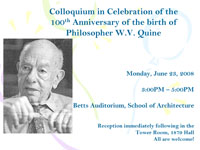 Ernie Lepore, Center for Cognitive Science, Rutgers University:
Introduction- Morton White, Professor Emeritus, School of Historical Studies, Institute of Advanced Study Princeton:
Quine as Teacher, Friend, and Colleague - Dagfinn Føllesdal, Clarence Irving Lewis Professor of Philosophy at Stanford University (and) Professor emeritus at the University of Oslo:
The Public Nature of Language - Gilbert Harman, Stuart Professor of Philosophy, Princeton University:
Inscrutability and Indeterminacy - Stephen Stich, Professor of Philosophy, Rutgers University:
Quine and Cognitive Science - John Burgess, Professor of Philosophy, Princeton University:
Socratizing - Daniel Garber, Professor of Philosophy, Princeton University (and) Chair, Department of Philosophy:
How Quine Made Me an Historian of Philosophy - Anthony Appiah, Laurance S. Rockefeller University Professor of Philosophy, Princeton University (and) the University Center for Human Values:
A chapter of psychology - Paul Boghossian, Silver Professor of Philosophy, New York University:
Meaning and Analytic Truth - Delia Graff Fara, Associate Professor of Philosophy, Princeton University:
Socratizing - Jason Stanley, Professor of Philosophy, Rutgers University:
Quine's influence on 20th C Philosophy of Language (text) - David Schrader, Executive Director of the American Philosophical Association:
Quine and the APA - Douglas Quine, W. V. Quine literary estate (and) Fellow, Pitney Bowes Advanced Concepts and Technology:
Mortui Vivos Docent - the Pleasure of Learning from Quine's Archives (text)  Ernie Lepore, Center for Cognitive Science, Rutgers University:
Concluding remarks
-
Homenaje a W. V. O. Quine (con ocasi n del centeranio de su nacimiento), UNMSM, Lima, Peru - Friday, June 20, 2008 at 11 am in Auditorio de la Facultad de Letras y Ciencias, Humanas de la UNMSM:
- Presentacion: Oscar Garcia Z rate
- Expositores:
Luis Piscoya Hermoza
Javier Vidal L pez
 Quine Centennial Symposium, CSMN, Oslo, Norway (Undervisningsrom 1, Georg Sverdrups hus, Blindern campus) - Tuesday, June 17, 2008
from 9:15 to 17:30. The "Quine Centennial Symposium" has been organized by Professor Dagfinn Føllesdal:- 9:15 - 9:30 Dagfinn Føllesdal, CSMN, and C.I. Lewis Professor of Philosophy, Stanford University,
Introduction: W.V. Quine, 25 June, 1908 - 25 December, 2000 - 9:30 - 11:00 Gerald J. Massey, Distinguished Service Professor of Philosophy, Emeritus, University of Pittsburgh:
Duhem and Quine: Bedfellows or Antagonists? - 11:15 - 12:45 Peter Hylton, Professor of Philosophy and UIC Distinguished Professor at the University of Illinois in Chicago:
Quine and the Aufbau: the possibility of objective knowledge - 13:00 - 14:00 Lunch
- 14:15 - 15:45 Charles Parsons, Edgar Pierce Professor of Philosophy, Emeritus, Harvard University:
Quine's nominalism - 16:00 - 17:30 Thomas Ricketts, Professor of Philosophy, University of Pittsburgh:
Quine on Reference, Ontology, and Truth
- 9:15 - 9:30 Dagfinn Føllesdal, CSMN, and C.I. Lewis Professor of Philosophy, Stanford University,
- A centennial conference on W.V. Quine: From Empiricism to Pragmatism
was organized and held by the Philosophy Institute, University of Warsaw, June 8-9, 2008
Brudzinski Conference Room, Kazimierzowski Palace, Warsaw University, Krakowskie Przedmiescie 26/28:- Organizing Committee:
- Jacek HOL WKA
- Bogdan DZIOBKOWSKI
- Program (PDF in Polish):
Monday, June 9 - 10:30 - 10:40 Jacek HOL WKA: Opening Remarks and Welcome
- 10:40 - 11:00 Jacek J. JADACKI: On Quine's Philosophical Ideas and Whether They Will Last
Session 1. Chair: Jacek J. Jadacki - 11:00 - 11:45 Jacek HOL WKA: Mental Entities
- 11:45 - 12:30 Ryszard W JCICKI: Dogmas of Logical Empiricism
- 12:30 - 13:15 Joanna ODROWAZ-SYPNIEWSKA: Count and Mass Natural Kind Terms
- 13:15 - 14:00 Krzysztof W JTOWICZ: Quine's Philosophy of Mathematics
Session 2. Chair: Jan Wolenski- 15:00 - 15:45 Adam GROBLER: Quine on Existence
- 15:45 - 16:30 Arkadiusz CHRUDZIMSKI: Ontological Commitments
- 16:30 - 17:15 Andrzej BILAT: Is the First Order Logic the Right Logic?
- 17:15 - 18:00 Barbara STANOSZ: Quine's Metaphilosophy
- 18:00 - 18.45 Jacek PASNICZEK: The Criterion of Ontological Commitment
- Cocktails
Tuesday, June 10
Session 3. Chair: Bogdan Dziobkowski- 11:00 - 11:45 Jan WOLENSKI: Analyticity, Empiricism, Apriorism
- 11:45 - 12:30 Cezary CIESLINSKI: On Truth and Analyticity
- 12:30 - 13:15 Adam NOWACZYK: The Enigmacy of Reference
- 13:15 - 14:00 Pawel GRABARCZYK: The Indeterminacy of Translation and Reference
Session 4. Chair: Jacek Hol wka- 15:00 - 15:45 Adam CHMIELEWSKI: On the Notion of Radical Interpretation
- 15:45 - 16:30 Justyna GRUDZINSKA: Quotations and Belief Reports. Quine on Linguistic Metarepresentations
- 16:30 - 17:15 Piotr WILKIN i Tadeusz CIECIERSKI: Why Modal Logicians Need Not Worry About Quine's Arguments?
- 17:15 - 18:00 Bogdan DZIOBKOWSKI: Quine's Naturalism
- Organizing Committee:
- W. V. Quine books for the 2008 centennial year:
 Confessions of a Confirmed Extensionalist and Other Essays (Dagfinn Føllesdal & Douglas B. Quine, editors) descriptive cutsheet for 2 books
Introduction ...... 1
I. Previously Unpublished Articles (*)- Nominalism (1946*) ...... 7
- On the Notion of an Analytic Statement (1946*) ...... 24
- Lectures on David Hume's Philosophy (1946*) merged version ...... 36
- The Importance of Logic for Philosophy (1947*) ...... 137
- Where is Logic Going? (1947*) ...... 148
- Animadversions on the Notion of Meaning (1949*) ...... 152
- The Entangled Philosophies of Mathematics (1950*) ...... 157
- Meaning (1959*) ...... 163
- The Way The World Is (1986*) ...... 166
- Pressing Extensionality (1992*) ...... 172
- Innate Foundational Endowments (1996*) ...... 176
- The Growth of Mind and Language (1997*) ...... 182
- Relations and Reason (1939) ...... 195
- On the Reasons for Indeterminacy of Translation (1970) ...... 209
- Methodological Reflections on Current Linguistic Theory (1970) ...... 215
- On Empirically Equivalent Systems of the World (1975) ...... 228
- Mind and Verbal Dispositions (1975) ...... 244
- The Nature of Natural Knowledge (1975) ...... 257
- Facts of the Matter (1977) ...... 271
- Cognitive Meaning (1979) ...... 287
- Grammar, Truth, and Logic (1980) ...... 303
- Ontology and Ideology Revisited (1983) ...... 315
- Relativism and Absolutism (1984) ...... 319
- States of Mind (1985) ...... 323
- The Sensory Support of Science (1986) ...... 327
- Panel on Reference (1986) ...... 338
- Indeterminacy of Translation Again (1987) ...... 341
- Mind, Brain, and Behavior (1989) ...... 347
- The Elusiveness of Reference (1990) ...... 352
- The Phoneme's Long Shadow (1990) ...... 364
- Three Indeterminacies (1990) ...... 368
- Preface to The Logic of Sequences (1990) ...... 387
- Two Dogmas in Retrospect (1991) ...... 390
- Structure and Nature (1992) ...... 401
- Commensurability and the Alien Mind (1992) ...... 407
- In Praise of Observation Sentences (1993) ...... 409
- Truth (1994) ...... 420
- Promoting Extensionality (1994) ...... 438
- Indeterminacy Without Tears (1994) ...... 447
- Assuming Objects (1994) ...... 449
- Naturalism; Or, Living within One's Means (1995) ...... 461
- Progress on Two Fronts (1996) ...... 473
- The Flowering of Thought in Language (1997) ...... 478
- I, You, and It: an Epistemological Triangle (1999) ...... 485
- Three Networks: Similarity, Implication, and Membership (2000) ...... 493
- Confessions of a Confirmed Extensionalist (2001) ...... 498
Index ...... 513- Nominalism (1946*) ...... 7
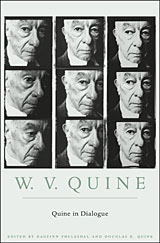 Quine in Dialogue (Dagfinn Føllesdal & Douglas B. Quine, editors) descriptive cutsheet for 2 books
Introduction ...... 1
I. Interviews- The Ideas of Quine (1978) ...... 5
- Willard Van Orman Quine (1985) ...... 18
- Quine Speaks His Mind (1988) ...... 21
- Philosophy (1993) ...... 30
- W. V. Quine: Perspectives on Logic, Science and Philosophy (1994) ...... 43
- Twentieth-Century Logic (1994) ...... 57
- Interview with Quine (1994) ...... 69
- There Is Always a Further Step (1998) ...... 82
-- Correspondence
- Logical Correspondence with Russell (1937-1967) ...... 103
- Thoughts on Reading Father Owens (1967) ...... 115
- Carnap's Positivistic Travail (1984) ...... 119
- Events and Reification (1985) ...... 129
- Carnap (1987) ...... 142
- Charles Sanders Peirce (1989) ...... 146
- Let Me Accentuate the Positive (1990) ...... 149
- Exchange between Davidson and Quine (1994) ...... 152
- Foreword in Kurt Godel (1994) ...... 157
- Where Do We Disagree? (1999) ...... 159
- Review of Rudolf Carnap's Logische Syntax der Sprache (1935) ...... 169
- Review of Jeffreys' Scientific Inference (1937) ...... 173
- Review of Goodman's Structure of Appearance (1951) ...... 176
- Review of Geach's Reference and Generality (1964) ...... 184
- Review of Lakatos' Proofs and Refutations (1977) ...... 189
- Review of Bickerton, Roots of Language (1983) ...... 192
- Review of Parsons' Mathematics in Philosophy (1984) ...... 194
- Four Hot Questions in Philosophy: PF. Strawson. Skepticism & Naturalism (1985) ...... 206
- Replies to Professor Riska's Eight Questions (1992) ...... 213
- Comment on "Carnap and Quine" by Neil Tennant (1994) ...... 216
- Responses (1994) ...... 223
- Reactions (1995) ...... 235
- Responses to seven essays (1997) ...... 251
- Response to Leemon McHenry (1997) ...... 257
- Quine's responses (1999) ...... 259
- Introducing Piaget (1960*) ...... 271
- Mind-Body Problem (1963*) ...... 273
- Magna Carta (1963) ...... 275
- On the Map (1964) ...... 278
- Charting the World (1965) ...... 280
- Words Enough (1969) ...... 285
- Skinner Retirement Party (1974*) ...... 291
- A Letter to Mr. Ostermann (1975) ...... 293
- Farewell Thanks at Villa Serbelloni, Italy (1975*) ...... 297
- Introducing Church (1975*) ...... 298
- Introducing Dummett (1976*) ...... 300
- Introducing Campbell (1977*) ...... 301
- Knights and Knaves on: Smullyan. What is the Name of this Book? (1978) ...... 303
- Gail Caldwell Stine Memorial Lecture (1980*) ...... 306
- What I Believe (1984) ...... 307
- Sticks and Stones; or, the Ins and Outs of Existence (1984) ...... 312
- Introducing Kripke (1984*) ...... 325
- Van Heijenort Memorial (1986*) ...... 327
- Books That Mattered to Me (1986) ...... 328
- To a Graduate Student in Philosophy (1988) ...... 330
- Life is Agid (1988) ...... 333
- Philosopher's Concern with Language (Words Are All We Have to Go On) (1992) ...... 334
- Hobbling the Hawkers (1992) ...... 340
- Introducing Shepard (1994*) ...... 342
- In Memory of John Finley (1995*) ...... 344
- Willard Van Orman Quine in "Dictionary of Philosophy" (1996) ...... 346
- Kyoto Acceptance Speech (1996) ...... 349
- Tidy Parsimony (1996) ...... 351
- Advice to the Next Generation (2002) ...... 358
- Farewell to Me (1978*) ...... 359
Index ...... 369- The Ideas of Quine (1978) ...... 5

![[w v quine autobiography book cover]](https://www.wvquine.org/wvq-bio.jpeg)
W. V. Quine's Books and translations (11 pages)
This bibliography includes all known books, revised editions, and translations of the books written by W. V. Quine.
W. V. Quine's Posthumous Collections
- Philosophy of Quine (5 volumes) (Dagfinn Føllesdal, Editor) - table of contents
- Quintessence - Basic Readings from the Philosophy of W. V. Quine (Roger Gibson, editor)
- Confessions of a Confirmed Extensionalist and Other Essays (Dagfinn Føllesdal & Douglas B. Quine, editors)
- (see above for table of contents)
- Quine in Dialogue (Dagfinn Føllesdal & Douglas B. Quine, editors)
- (see above for table of contents)
W. V. Quine's Essays, Articles, Reviews, and Abstracts (11 pages)
This bibliography includes all known essays, articles, and reviews written by W. V. Quine together with a major reprint citation if available. It is based upon the extensive bibliographies published by Eddie Yeghiayan (Special Collections, Main Library, University of California, Irvine, CA ), The Philosophy of W. V. Quine (P. A. Schilpp, editor) and Essays on the Philosophy of W. V. Quine (R. W. Shahan and Chris Swoyer, editors).
Fiction by W. V. Quine
- 1951. It Tastes Like Chicken in Furioso: Winter 1951 pp. 37-39
- 1989. (1951 story, reprinted) It Tastes Like Chicken in Delos: Spring 1989, pp. 139 - 141
Selected Popular Book Reviews by W. V. Quine
- 1963, Sept. 26. Magna Carta on: National Geographic Atlas. -- In: New York Review of Books 1(3): 8
- 1964, Jan. 9. Mencken on: HL. Mencken. The American Language. -- In: New York Review of Books 1 (9): 7 [reprinted in W. V. Quine's Theories and Things]
- 1964, Mar. 5. On The Map on: The Atlas of Britain and Northern Ireland -- In: New York Review of Books 2 (2): 17
- 1964, July 9. Science and Truth on: JJC. Smart. Philosophy and Scientific Realism -- In: New York Review of Books [reprinted in W. V. Quine's Theories and Things]
- 1965, Sept. 30. Charting the World on: L. Bagrow. History of Cartography -- In: New York Review of Books 5 (4): 18
- 1968, May 5. Of: Times Atlas of the World. -- In: Book World (Washington Post & Chicago Tribune): page 7 [reprinted in W. V. Quine's Theories and Things]
- 1969, Dec. 4. Words Enough on: The American Heritage Dictionary of the English Language; Random House Dictionary of the English Language, College Edition. -- In: New York Review of Books 13 (10): 3
- 1978, May 28. Knights and Knaves on: Smullyan. What is the Name of this Book? -- In: New York Times Book Review, pp. 6, 17 [title corrected Sept. 9, 2007; previously incorrectly confused with review below]
- 1978, Nov. 23. Otherworldly on: N. Goodman. Ways of Worldmaking. -- In: New York Review of Books [reprinted in W. V. Quine's Theories and Things]
- 1985, Feb. 14. Four Hot Questions in Philosophy on: PF. Strawson. Skepticism and Naturalism: Some Varieties (The Woodbridge Lectures, 1983). -- In: New York Review of Books
Books and Essays on W. V. Quine (some Roger Gibson Annotations)- 7 page list
Reviews and Announcements of W. V. Quine's Books
- Methods of Logic, third edition: RBJ's Bibliography and notes
- Mathematical Logic Comprehensive book review in Bactra: Informal logic is an inescapable part of life as a human being with a plugged-in brain, and not a vegetable or a raving lunatic; even post-structuralists and critical theorists may be observed, off-duty, saying ``That can't be right, because...'' Formal logic is a notoriously dry subject, initiated in the West by the prince of pedants, Aristotle. Mathematical logic, which has emerged only in the last hundred and fifty years, is well known to be abstruse and terrifying, and has made the logician into a creature mathematicians view in much the same way others view mathematicians, i.e. a repository of incomprehensible knowledge. When, in 1995, the Bertrand Russell e-mail list attempted to list all those who had read all three volumes of Whitehead and Russell's Principia Mathematica, they came up with less than two dozen names; two of those people died while the list was being compiled.....
- Philosophy of Logic RBJ's Bibliography and notes.
- Quiddities A book review by Danny Yee (danny@cs.su.oz.au ), Copyright (c) 1992. Quiddities is a collection of short pieces modeled on ...
- Quiddities Harvard University Press Bestsellers: "Quiddities is the work of an author who has faith in his own idiosyncratic"...
- The Time Of My Life. An Autobiography "Quine is a most elegant, perceptive, and entertaining writer, combining a poetic"...
Popular References to W. V. Quine
[Please E-Mail additional items to the webmaster:![[webmaster]](webmaster-link.gif) ... I'm missing many.]
... I'm missing many.]
- ADVERTISING
An Equitable Life Assurance Society recruiting advertisement from November 3, 1964 issue of the Daily Princetonian.
![[Equitable - Daily Princetonian cad]](https://wvquine.org/1964-WVQ cited in Equitable Life Insurance Ad-1964-11-03 Daily Princetonian 1325x513.jpg)
- CARTOONS
A brilliant XKCD cartoon referencing a "Quine" program.
![[XKCD cartoon]](https://imgs.xkcd.com/comics/open_mic_night.png)
Existential Comics: Dungeons and Dragons and Philosophers - Analytical Turn (preview)
![[Dungeons and Dragons cartoon]](https://www.wvquine.org/wvq-dungeons-and-dragons-detail-740.png)
Full Existential Comics: Dungeons and Dragons and Philosophers - Analytical Turn
- COMPUTER PROGRAMS and COMPUTER SCIENCE
- A computer program whose output is its own source code is called a "quine" after W.V. Quine. This self reproducing program usage was introduced by Douglas Hofstadter in his 1979 book, Godel, Escher, Bach: An Eternal Golden Braid. [thanks to en.wikipedia.org/wiki/Willard_Van_Orman_Quine for the citation]
- A number of clever computer aphorisms, computer error messages written as haikus, and "quine" self reproducing programs written in various computer languages: Aphorisms In Computer Science-Aforismen.pdf from the Delft University of Technology website [thanks to TT].
- GAME SHOWS
- Jeopardy! Game Show: Category "Wise Guys" on game #3218 on Sept 9, 1998 for $400 in the Double Jeopardy! Round:
"Logician Willard Van Orman Quine is from Akron in this state--we wanted an excuse to say Willard Van Orman Quine" - Jeopardy! Game Show: Category "Quasi-Stupid Answers" on game #5678 on April 22, 2009 for $600:
"Philosopher Willard van Orman Quine said that this philosopher's "predicament is the human predicament"
- Jeopardy! Game Show: Category "Wise Guys" on game #3218 on Sept 9, 1998 for $400 in the Double Jeopardy! Round:
- MOVIES
- Gavagai is a 2016 Norwegian drama film directed by Rob Tregenza. The Gavagai_(film) was acclaimed by critics. The movie is named after Willard Van Orman Quine's famous invented word "gavagai" which was used in his book Word and Object to illustrate the indeterminacy of translation.
- MUSICAL TRIBUTES
- The international 21st Century Monads have recorded (2009) a beautiful MP3 song Willard Van Orman Quine with clever lyrics by Carrie Jenkins. A number of their songs with philosophical themes (lyrics are displayed by clicking in the lower left of each song entry) were posted at their now defunct (https://people.umass.edu/phil511/monads/) 21st Century Monad MP3 website. The song was (2013) also available as a (https://www.youtube.com/watch?v=Gzz4ZqZ74Bg) solo video but is now unavailable.
- Professor Warren Goldfarb started the musical tributes in 1978 with Major General Quine. (see also Musical Tributes on the About Quine web page)
- NEWSPAPER ARTICLES
- Johnson, G. 1995. "O.J. Meets Willard Quine" The New York Times, Sunday May 21, Section 4; Page 1 (Ideas & Trends: Imaginary Witness; O.J.'s Blood and the Big Bang, Together at Last)
- NON-FICTION BOOKS / LECTURES
- Hardcastle, Gary. 1996. "Themes in Contemporary Analytic Philosophy... as Reflected in the Work of Monty Python". This talk was written in response to a request from the Philosophy Club at Virginia Tech. Comments from Python fans, philosophers, interested bystanders, raving loonies, and any combination of the above are welcomed! - Gary L. Hardcastle (garyh@vt.edu) Department of Philosophy/Center for the Study of Science..., 27Apr96
- NOVELS / MOVIES
- Boyd, William. 1998. William Boyd's novel "Armadillo" begins with a quote by Quine. The book was recently made into a movie by A&E in collaboration with the BBC (2002) - Eric Thrane.
- McCarthy, Cormac. 2022. Cormac McCarthy's novel, "Stella Maris". In this passage, the principle character in the novel a woman is speaking with a psychiatrist in the Mental Institution from which the book takes its title...Stella Maris. A child prodigy who breezed through post-graduate mathematics in her early teens she has committed herself voluntarily to Stella Maris. She seeks no therapy and will not even allow attempts. She just feels more at home around the inmates than she does "on the outside". Here you go...
That’s impressive. How much money had you inherited?

My share was something over a half million dollars. I thought the violin was a good idea. Even if I did worry about leaving it in my room.
I used to keep it under the pillow. For a while I actually kept the money in a shoebox in the closet.

You had the money in cash?

Yes. When my brother found out he made me rent a safe deposit box.

You didn't consider investing it?

We’d inherited the money and we didnt owe any taxes on it. But we couldn't prove that. It was buried in my grandmother’s basement.
She told us where it was and that we were to have it. But of course there wasnt any documentation for it. She’d buried the money in her
basement. Our grandfather had. It was in twenty dollar goldpieces. Stacked in lengths of lead pipe.

This is turning into a fairly curious tale.

People do curious things.

Christie’s. You bought the violin at auction?

Yes. I bought it through Bein & Fushi. In Chicago. They weren't really even in business yet. But they acted as my agents. They wouldn't
have had an instrument like that in stock. No. They didn't have any stock. They were a brand-new company.

I can see how you would be concerned about it.

When a Cremona is stolen it can be stolen forever. One more of a handful that might never be found. I’d thought about painting it. Some
sort of water soluble paint that would be easy to get off without damaging the finish. Paint it gold, maybe. Put it in a cheap case. But
I thought about the quotation that Quine cites. Save the surface and you save all. Anyway I knew I couldn't bring myself to do it.

Who’s Quine?

He’s a philosopher. Some say the greatest living.

Do you?

Maybe. Of course he thinks he understands mathematics. Can't seem to leave it alone.

But that’s a quote, you said.

Yes. It’s in the frontispiece of one of his books.

Does he give an attribution?

Yes. Sherwin-Williams.

The paint company.

Yes.

You’re joking.

No. I’m not. Neither was Quine. Well. Maybe a little. Maybe quite a bit now that I think about it.

--- thanks to Allen Ackerman, May 15, 2023
- PHILATELIC / STAMP COLLECTING
- Centennial of a Philatelic Philosopher in Philatelic Literature Review 2008 (4th quarter): pp. 326-337 by Douglas B. Quine captures Quine's philatelic connections (see 2008 WV Quine news at top this web page) and in www.wvquine.org/wvq-avocation.html "Philately - Stamp Collecting"
- Personalized W. V. Quine postage stamp (see top right corner of this web page)
- POEMS / LIMERICKS
- Quine limerick (via Jason Zarri) by the late Timothy Sprigge probably in early 2001 as a verse in his history of philosophy limerick saga:
A man from Ohio now dead Would lurk in the fields, so it is said, So that when others screamed "rabbit" He could indulge in his habit Of shouting "Gavagai" instead. - Poem on Quine ... [ cold link "https://drip.colorado.edu/~tromey/poetry/quine.html" last seen March 2, 2005]
There's a piece of text he loves; he cherishes it, runs thought's thumb over its folds. It slots into itself, or his mind does, expending itself helically downward, following the natural flow of the words. Deeper now into the depths he goes, pondering its every line, tracing its hidden referents with invisible fingertips. Every whorl of his prints silently points to this poem which in part reads, "His mind nimbly traverses the tumbling of infinity", and he realizes what they meant when they said that every poem was written for him. - Philosophical Ponticifcations: Philosophy Limerick of the Day: Quine - June 17, 2013 also Scholardarity
         Willard V. Quine had a plan
         To put analyticity under the ban
         He scotched the Two Dogmas, and fought ever onwards
         To show modality was a sham

              POSTED BY JASON ZARRI AT 3:21 PM, June 18, 2013
- Quine limerick (via Jason Zarri) by the late Timothy Sprigge probably in early 2001 as a verse in his history of philosophy limerick saga:
- PORTRAITS
- Quine caricature accompanying Episode 66 Quine on linguistic meaning and science blog discussion (see 2012 WV Quine news at top this web page)
- POSTMARKS
- Quine, Douglas. 1991. "Philosophical Quine Commemorated by San Marino Postmark." Linn's Stamp News (Aug. 19 91): 14
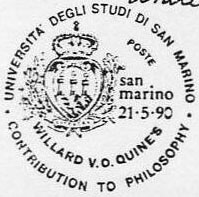
- Quine, Douglas. 1991. "Philosophical Quine Commemorated by San Marino Postmark." Linn's Stamp News (Aug. 19 91): 14
- TOYS - Humorous References to W. V. Quine

reprinted with permission from the Philosophical Powers Action Figure Web Site by Ian Vandewalker
- TYPEWRITER
- W. V. Quine used his 1927 Remington typewriter throughout his professional life with a modified keyboard that included specialized characters for his work. It was the subject of a fascinating 2021 article by Mel Andrews in the Early Typewriter Collector's Association journal: Quine's Remington portable No. 2
- WORD GAMES
- From PLATO to QUINE in 7 steps by W. V. Quine [This was found by Paul Gregory, a philosopher from Washington and Lee University,
in the W. V. Quine archives in the Harvard University Houghton Library in September 2006. In a Dexter shoebox (size 6-1/2 W, Navy "Pacer"s)
full of 3x5 note cards, was a card on which Quine wrote, down the length of the left side:]
         PLATO
         PLATE
         SLATE
         SPATE
         SPITE
         SUITE
         QUITE
         QUINE
- From PLATO to QUINE in 7 steps by W. V. Quine [This was found by Paul Gregory, a philosopher from Washington and Lee University,
in the W. V. Quine archives in the Harvard University Houghton Library in September 2006. In a Dexter shoebox (size 6-1/2 W, Navy "Pacer"s)
full of 3x5 note cards, was a card on which Quine wrote, down the length of the left side:]
Residences of W. V. Quine (corrections welcomed)
- (1908-1909) 396 Nash Street, Akron, Ohio
- (1909-1919) 38 Hawthorne Street, Akron, Ohio
- (1919-1926) 16 Orchard Road, Akron, Ohio
- (1926) 111 Forest Street, Oberlin, Ohio
- (1927-1930) 30 East Lorain Street, Oberlin, Ohio "Arthron" house story and photograph
- (1930-1931) 13 Howland Street, Cambridge, Massachusetts
- (1931-1932) 888 Massachusetts Avenue, Cambridge, Massachusetts
- (1932-1933) Pension Wagner-Szamvald, Hörlgasse, Vienna, Austria
- (1933) Hotel Victoria, Ulic Jasna 26, Warsaw, Poland
- (1933) Pension Fiser, Na Petrska 3, Prague, Czechoslovakia
- (1933) Schwarzspanierstrasse, Vienna, Austria
- (1933-1934) Ridgely Hall, 65 Mount Auburn Street, Cambridge, Massachusetts
- (1934-1935) 52 Garden Street, Cambridge, Massachusetts
- (1935-1936) 91 Washington Street, Cambridge, Massachusetts
- (1936-1937) 61 Frost Street, Cambridge, Massachusetts
- (1937-1938) 21 Waverly Avenue, Newton, Massachusetts
- (1938) 76 Grozier Road, Cambridge, Massachusetts
- (1938-1939) Rua da Misericordia 29, Ponta Delgada, Azores
- (1939-1940) (?) 76 Grozier Road, Cambridge, Massachusetts
- (1940-1942) 65 Sparks Street, Cambridge, Massachusetts
- (1942 summer) Brazil
- (1942-1943) 843 Fifty-first Street, S.E., Washington DC
- (1943-1944) 1006 Elm Street, Takoma Park, Maryland
- (1944-1945) North Danville Street, Arlington, Virginia
- (1945-?) 9 Ware Street, Cambridge, Massachusetts
- (1948-1949) North Main Street, Nashua, New Hampshire
- (1949 summer) 34 Haldeman Road, Santa Monica, California
- (1949-) Harvard Street, Cambridge, Massachusetts
- (1951-1958) 291 School Street, Belmont, Massachusetts
- (1953-1954 Sabbatical at Oxford) 8A Merton Street, Oxford, England; side entrance was 8 Logic Lane
- (1956-1957 Sabbatical at Princeton University) Maxwell Lane, Princeton, New Jersey
- (1957-1998, summers when not elsewhere) General Delivery, Harvard, Massachusetts
- (1958-1959 Sabbatical at Stanford University) 743 Cooksey Lane, Stanford, California
- (1958-2000, when not elsewhere) 38 Chestnut Street, Boston, Massachusetts
- (1965 spring Sabbatical at Wesleyan University) 35 Home Ave, Middletown, Connecticut
- (1968 spring Sabbatical at Rockefeller University) Rockefeller University, York Avenue, New York, New York
- (1973-1974 Sabbatical at Oxford University) 9 Holywell Street, Oxford, England
Newspaper Profiles of W. V. Quine
![[W V Quine age 40 and Marjorie Boynton Quine]](https://www.wvquine.org/wvq-age40.jpg)
passport age 40 with wife Marjorie
WVQ Obituaries, Memorials, Symposia, and Photographs
- PHOTOGRAPHS of W. V. Quine through 10 decades of life
- MEMORIALS and W. V. Quine SYMPOSIA
- OBITUARY LIST for W. V. Quine
- MEMORIAL TALK TEXTS for W. V. Quine
- MEMORIAL TALK TEXTS (continued) for W. V. Quine
- W. V. Quine Guest Book - including personal messages and obituaries
"Earned" Degrees
- Oberlin College, Oberlin, Ohio; 1930 (BA)
- Harvard University, Cambridge, MA; 1931 (MA)
- Harvard University, Cambridge, MA; 1932 (PhD)
Honorary Degrees
- Oxford University, Oxford, England; 1953 (MA)
- Oberlin College, Oberlin, Ohio; June, 1955 (LittD)
- Ohio State University, Columbus, Ohio; June 7, 1957 (LLD)
- I now have the honor to present for the honorary degree Doctor of Laws, Willard Van Orman Quine, Edgar Pierce Professor of Philosophy, Harvard University.
Willard Van Orman Quine was born in Ohio and received the degree of Bachelor of Arts from Oberlin College, the degree of Master of Arts from Oxford University, and the degrees of Master of Arts and Doctor of Philosophy from Harvard University. After holding fellowships for study in Europe and after being a member of the Society of Fellows at Harvard University from 1933 to 1936, he began his teaching service at Harvard University. He is Edgar Pierce Professor of Philosophy at that institution and was Chairman of its Philosophy Department from 1952-53. In 1942, Dr. Quine was Visiting Professor at the University of Sao Paulo, Brazil, and during the year 1953-54 he was a fellow of Balliol College and George Eastman Visiting Professor at Oxford University. During the present year he is a member of the Institute of Advanced Study. Among the numerous honors and recognitions his professional colleagues have bestowed upon him are the Presidency of the Association of Symbolic Logic, and the Presidency of the Eastern Division of the American Philosophical Association. In 1955 Oberlin College conferred upon him a doctorate of literature.
Besides being a co-author of three books, the author of numerous papers in professional journals, many of which have had more impact upon scholarship in philosophy and logic than most books, Professor Quine has written five books and has two more in progress.
Professor Quine's creative work has earned him world-wide recognition as the successor of Frege, Whitehead, and Russell in a period of logical discovery and development never before equalled in the history of philosophy. Like his worthy predecessors, Professor Quine has sought an integration of mathematical logic and certain related metaphysical themes in philosophy. His many books and articles testify to his brilliant synthesizing spirit of logic and philosophy which represents one of the foremost intellectual movements in our day.
In recognition of his scholarship in the field of logic and for his contributions to the literature of philosophy, I now present Willard Van Orman Quine for the honorary degree, Doctor of Laws.
- I now have the honor to present for the honorary degree Doctor of Laws, Willard Van Orman Quine, Edgar Pierce Professor of Philosophy, Harvard University.
- University of Lille, France; October, 1965 (LLD)
- University of Akron, Akron, Ohio; December, 1965 (LittD)
- Washington University, St. Louis, Missouri; June 5, 1966 (LittD)
- University of Chicago, May 5, 1967 (LHD)
- Mr. President, I have the honor to present, as a candidate for an honorary degree, Willard Van Orman Quine, Edgar Pierce Professor of Philosophy at Harvard University.
Distinguished for his contributions to mathematical logic, Professor Quine has achieved new standards of clarity and rigor in philosophical reasoning. His formulation of the problem of ontic commitment in the terms of quantificational logic has given philosophy a new locus for the examination of ontological issues. Through his penetrating analyses of analyticity, synonyomy, propositional attitudes and other fundamental concepts he has brought philosophers of all convictions to a critical re-examination of their basic principles.
In recognition of his outstanding service to philosophy, Mr. President, I request, on behalf of the Division of Humanities, that you confer upon Willard Van Orman Quine, the honorary degree of Doctor of Humane Letters.
- Mr. President, I have the honor to present, as a candidate for an honorary degree, Willard Van Orman Quine, Edgar Pierce Professor of Philosophy at Harvard University.
- Temple University, Philadelphia, Pennsylvania; June 1970 (LittD)
- (by Sidney Axinn) - In a moment of world history when man too rarely reflects upon the tumultous events of this Twentieth Century, he has contributed immensely towards the understanding of man and his condition.
A distinguished scholar and writer in the field of philosophical studies, he has earned pre-eminence in the study of philosophy of logic throughout forty years of dedication to teaching, research, and writing.
His numerous honors and distinctions include the George Eastman Visiting Professorship at Oxford, the Gavin Young Lectureship at the University of Adelaide (Australia), appointment as a fellow of Balliol College and in the Institute of Advanced Studies, and his service with distinction as Edgar Pierce Professor of Philosophy at Harvard University.
I am privileged and pleased to present a distinguished colleague for the honorary degree of Doctor of Literature --.
- (by Sidney Axinn) - In a moment of world history when man too rarely reflects upon the tumultous events of this Twentieth Century, he has contributed immensely towards the understanding of man and his condition.
- Oxford University, Oxford, England; June 1970 (DLitt) [citation translated from Latin and Greek; click on image enlarged]
 Livy reports thatr Attus Navius cut a whetstone in half with a razor; a sharper razor of the spirit, however, was invented by William of Ockham, the 'invincible doctor', and though only as an 'inceptor', not a Master, he honed it here in Oxford. The cutting-edge of logic has been tempered anew in our time, and our guest to-day has taken possession of the instrument to shave off every abstraction as though it were an infection. He is a new 'nominalist' who rejects universals. He even attempts the Shaving of Plato, although Plato would have greatly approved of one so far from 'innocent of geometry', a skilled dialectician and pursuer of mathematical reasoning. As natural scenery, it is not verdant vales, banked with rustling boskage, that delight him, but desert landscapes. So too in philosophy he would have things plain and solid, no suggestion of 'more things than are drempt of'. For him, being is not to be perceived or to be thought, but to be the value of a variable. However he allows that some entities should be multiplied, his own books for instance (from A System of Logic, 1934, to nos. 11, Ontological Relativity, and 12, Philosophy of Logic, 1969), and his knowledge of languages and etymologies. When he is your guest, do not apply Ockam's razor; he is not a water drinker. He writes copiously, at once like an angel and like an American, with a Roman ruthlessness, a patrician elegance, and the subtlety of Zeno. His origins are Dutch and Isle of Man (where by way of etymology, his name means son of John, McIan), and his birthplace, Akron, Ohio, provides an omen, like Sappho's apple, 'top of the topmost, and the applepickers have forgotten it; no, not forgotten, but they could not reach it.' But he classes himself more modestly; if a cricket eleven of logicians were to be chosen from all past time, he would not figure except as captain of the second eleven. I present to you Willard Van Orman Quine, Professor of Philosophy at Harvard, Eastman Visiting Professor here (1953-4), Fellow of the American Academy of Arts and Sciences, and of the American Philosophical Society, corresponding Fellow of the British Academy, a notable philosopher and pioneer in Symbolic Logic, for admission to the degree of Doctor of Letters honoris causa.
Professor Quine, like Parmenides of old, has so successfully triumphed over the thorny problems of logic that he can express in ordinary language ideas of great complexity. I admit him to the degree of Doctor of Letters.
- Cambridge University, Cambridge, England; June 1978 (LittD) [citation translated from Latin; click on image to enlarge]
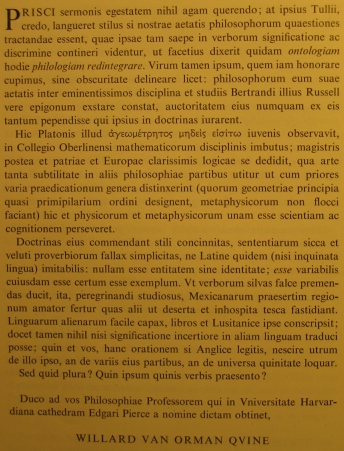 Complaining of the limitations of the traditional language will get me nowhere. But even Cicero's pen, I think, might drag if he had to deal with the topics of modern philosophy, which so often appear to be involved with the meaning and distinction of words that someone has wittily said that nowadays ontology recapitulates philology. But the man himself, whom we now desire to honour, we can outline without obscurity. It is generally agreed that he is one of the most eminent philosophers of his time, in interests and methods a true successor of the great Bertrand Russell; and that his influence has never depended solely upon his own adherents.
As a young man he observed Plato's injunction, Non-mathematicians keep out and after taking his degree in mathematics at Oberlin College devoted himself to logic under the most celebrated masters both of his own country and of Europe. That technique he has applied with such great finesse in other departments of philosophy that where his predecessors have distinguished various classes of propositions (of which those of mathematics are given pride of place while those of metaphysics are regarded as worthless) he stresses the unity of science and metaphysics.
The appeal of his teaching owes much to the elegance of his style, and to the terse and deceptively simple and proverbial quality of his maxims, scarcely to be imitated even in Latin without some inquination of the language: no entity without identity, for example, or to be is to be the value of a variable. As in language he reckons that the jungle should be cut back, so too as a keen traveller he is said to be especially fond of those parts of Mexico which others find distasteful and inhospitable deserts. He has an easy control of foreign languages, and has himself written books in Portuguese. But he teaches that nothing can be translated into another language without some indeterminancy of meaning; that if you are reading this speech in English you cannot know whether I am talking about the man himself, about his sundry parts, or about the universal, Quinehood.
But without more ado let me present the man himself,
- Harvard University, Cambridge, Massachusetts; June 1979 (LLD)
- Willard Van Orman Quine: Doctor of Laws: Beyond philosophical dispute a great logician who has left a lasting imprint on his field; within our special compass a friendly teacher, a colleague of generous heart.
- Uppsala University, Uppsala, Sweden; June 1980 (DPh)Uppsala universitet. Hedersdoktorer Doctores honoris causa. Filosofie hedersdoktorer.
- Syracuse University, Syracuse, New York; May 1981 (LHD)
- Willard Van Orman Quine, your lucid and penetrating treatment of philosophical and logical issues has exercised an influence unsurpassed by the work of any other living American philosopher.
Your philosophical inquiry has formed the questions of this generation. Your criticism of Empiricist dogmas turned analytic philosophy in new directions and was a major force in moving American philosophy to the forefront in the Anglo-American world.
During your decades of unchallenged eminence, you have remained the fair, measured, and temperate scholar who generously offers opinion and comment to young philosophers and others whenever they seek your counsel..
- Willard Van Orman Quine, your lucid and penetrating treatment of philosophical and logical issues has exercised an influence unsurpassed by the work of any other living American philosopher.
- University of Bern, Bern, Switzerland; December 1982 (DPh)
- University of Granada, Granada, Spain; 1986 (DPh)
- Ripon College, Ripon, Wisconsin; May 15, 1983 (LittD)
- Adelphi University, New York, May 21, 1989 (LittD)
- Carl von Ossietzky University of Oldenburg, Oldenburg, Germany; June 1997 (Dr.phil.)


Awards and Offices
- Sheldon Traveling Fellow (Harvard University) 1932-1933 (Vienna, Prague, Warsaw)
- Society of Fellows (Harvard University), Junior Fellow, 1933-1936
- Harvard University, Instructor and Tutor in Philosophy, 1936-1941
- Harvard University, Associate Professor in Philosophy, 1941-1948
- Universidade de São Paulo, Brazil, Visiting Professor, 1942
- United States Navy, Lieutenant then Lieutenant Commander, active duty, 1942-1946
- Harvard University, Professor of Philosophy, 1948-1956
- Society of Fellows (Harvard University), Senior Fellow, 1949-1978
- American Academy of Arts and Sciences, fellow 1949 -
- Harvard University, Chairman, Philosophy, 1952-1953
- Association for Symbolic Logic, President, 1953-1955
- Bicentennial Silver Medallion, Columbia University, NY, October 13, 1954
- Harvard University, Edgar Pierce Professor of Philosophy, 1956-1978
- Institute for Advanced Studies (Princeton, NJ) 1956-1957
- Society of Fellows (Harvard University), Chairman 1957-1958
- American Philosophical Association, President 1957
- American Philosophical Society, member 1957 -
- Centre for Advanced Studies in the Behavioral Sciences (Palo Alto, CA) 1958-1959
- British Academy, corresponding fellow 1959 -
- Instituto Brasileiro de Filosophia, corresponding member 1963-
- Centre for Advanced Studies (Wesleyan University, Middletown, CT) 1965
- Nicholas Murray Butler gold medal, Columbia University, NY; June 2, 1970
- Sir Henry Saville Fellow, Merton College, Oxford University, 1973-1974
- National Academy of Sciences, Washington DC, fellow 1977 -
- Institut de France 1978 -
- Harvard University, Emeritus Professor of Philosophy, 1978 -
- Norwegian Academy of Sciences 1979 -
- F. Polacky gold medal, Prague, 1991
- Charles University, gold medal, Prague, 1993
- Rolf Schock Prize, Sweden; 1993 received from the hands of the King of Sweden together with a laurel wreath and a cannon salute [first award in 'Logic and Philosophy' to: 'Professor W. V. Quine, USA, for his systematical and penetrating discussions of how learning of language and communication are based on socially available evidence and of the consequences of this for theories on knowledge and linguistic meaning - in particular the works From a Logical Point of View (1953), Word and Object (1960), and Pursuit of Truth (1990, 1992)'.]
- Kyoto Prize, Kyoto, Japan; November, 1996 from Kyocera's Inamouri Foundation
- We watched the magnificent ceremony in Kyoto early November 10 as it unfolded across the Internet. The elegant hall, music, and flowers all created an ambiance to reflect this special event. For us the experience was an interesting study in contrasts with the traditional Japanese music and dress being complimented by the latest technology that enabled us to watch the ceremony as it happened with color still images every 15 to 60 seconds and a continuous sound feed that crackled in a muffled way much like an early short wave radio. We watched from home on a laptop computer with data pouring through the Internet and over the slow telephone line to our house. The gold medal and purple ribbon were an impressive sight even half way around the world! The Royal Prince and Princess added an element of tradition impossible in this country while we joined in spirit with President Bill Clinton's "delight to congratulate Willard Van Orman Quine" on an intellectual life dedicated to the betterment of humanity. We were pleased to hear the acceptance speech and see early family photographs as a life of research was recognized in a very special setting. The beautiful children's choir and symphony provided a fitting closing. - Doug (son)
Pronunciation of Quine
The Manx name 'Quine' is pronounced exactly as a native English reader should guess. Unfortunately, because the name is so rare, most people get it wrong because they don't trust their instincts (the name is not spelled 'Quinn' nor is it pronounced that way).
- The name may be phonetically represented as: /kwi:n/
- The "Q" sounds like "Kw" or the beginning sound of quick, queen, quarry, and quarter.
- The wordname rhymes with: dine, fine, line, mine, nine, pine, sine, tine, vine, and wine
- So overall the name sounds like: "Kwine"
- This Pronunciation of Quine information is also posted at a useful website: Pronounce Names
![[book cover]](https://www.wvquine.org/dare-1.jpg)
Quine and the Dictionary of American Regional English (DARE)
DARE is a multi-year project of the late Professor Frederic Cassidy - a close friend of Quine since high school days. All 5 volumes have been published and they are a wonderful source of information about the regional differences in English across the United States. This continuing monumental effort of research and documentation was a passion of Quine's. Memorial gifts to help continue the work may be made to DARE / University of Wisconsin Foundation, 1848 University Avenue, P.O. Box 8860, Madison, WI 53708
- Dictionary of American Regional English: Volume I: A-C (published February 1986) Amazon.com review: William Safire calls it "The most exciting linguistic project going on in the United States," and I'd have to agree. DARE is a corker (thing of remarkable quality or strength)...
- Dictionary of American Regional English: Volume II: D-H (published September 1991) Amazon.com review: Volume 2 is every bit as excellent as A-C, and as thought provoking. It's sad to have lost words like faunch (to rant, rage, or fret)...
- Dictionary of American Regional English: Volume III: I-O (published December 1996) Amazon.com review: We DARE fans who've been hemmed in by the Hs for too long can celebrate; Volume 3 has arrived. Finally one can troll I-O, collecting gems like jug-handle, kyoodle, lip battle, meech, numpy, and ouchy (treat unfairly, mutt, argument, cringe, dolt, and irritable)...
- Dictionary of American Regional English: Volume IV: P-Sk (published December 2002) Amazon.com comment by William Safire, New York Times Magazine, December 8, 2002 [This] is the penultimate (one more to go) volume in the set that no library can afford to absquatulate.
- Dictionary of American Regional English: Volume V: Sl-Z (published March 2012) Amazon.com comment DARE readers now have the full panoply of American regional vocabulary, from Adam s housecat to Zydeco. Volume V is filled with words that reflect our origins, migrations, ethnicities, and neighborhoods. Whether we are talking about foods, games, clothing, family, animals, or any other aspect of life, our vocabulary reveals much about who we are.
Quine in dictionaries
"Quinean" is a word in the Oxford English Dictionary, Supplement, 1987
- Quinean - adj. "Of, pertaining to, or characteristic of Willard Van Orman Quine or his theories"
"quine" is a word in the The Philosophical Lexicon, eighth edition: 1987, Daniel Dennett (editor), American Philosophical Association, 18 pages
- quine - v. "(1) To deny resolutely the existence or importance of something real or significant. "Some philosophers have quined classes, and some have even quined physical objects." Occasionally used intransitively, e.g., "You think I quine, sir. I assure you I do not!" (2) n. The total aggregate sensory surface of the world; hence quinitis, irritation of the quine."
"quine" is a word in The New Hackers Dictionary
quine /kwi:n/ [from the name of the logician Willard V. Quine, via Douglas Hofstadter] - n. A program that generates a copy of its own source text as its complete output. Devising the shortest possible quine in some given programming language is a common hackish amusement.
 Here is one classic quine (of several at the web site):
  ((lambda (x)
  (list x (list (quote quote) x)))
  (quote
  (lambda (x)
  (list x (list (quote quote) x)))))
This one works in LISP or Scheme. It's relatively easy to write quines in other languages such as Postscript which readily handle programs as data; much harder (and thus more challenging!) in languages like C which do not.. Some infamous Obfuscated C Contest entries have been quines that reproduced in exotic ways.
- Using a completely different approach, MrcredsAlex (closed blog https://mrcredsalex.blogspot.com) claims to have invented the shortest quine ever: Nothing. Nothing. That's it. There's nothing in the program. So the program prints nothing. And if a quine is printing the code of the program, then: code is nothing. we print nothing. So what we print and the code is the same thing.
- Mike Garrity reports (local copy
a "quine" variation which is something even trickier. When you run the program, it prints out the source for a program in a different language. If you run that program, it'll print out the source for a program in yet another language. So on and so forth, until the eleventh one prints out the original text! Go check it out on Yusuke Endoh's blog.
- The longest "chained" or "relay quine" that I know of (thanks to Alex Quine) is presented at the Yusuke Endoh "mame" web site and is diagrammed to the right.

"quine" has three definitions in The Urban Dictionary (July 28, 2012) deriving from Willard Van Orman Quine's writings
definition 2: quine A program that upon execution will reproduce its own source code.
definition 3: quine verb, to distort beyond recognition. Origin: In philosophy "to Quine" used to deny existence of entities that cannot be individuated or identified (after ontological methodology of W.V.Quine).
definition 4: quine forum acronym: quote is not edit. Refers to the situation when intending to edit your post you misclick and quote it instead, resulting in two identical posts; thence the second post you replace with 'edit:quine' Used at SA forums.
W. V. Quine's Ph.D. students - chronological list
- 1940, Leigh D. Steinhardt - later Leigh S. Cauman (Charles Morris)
- Leigh Steinhardt Cauman was Managing Editor of The Journal of Philosophy from 1960 until her retirement in 1987. She combined this position with teaching logic at the School of General Studies at Columbia University. She died March 23, 2015.
- 1942, George D. W. Berry (H. M. Sheffer)
- George D. W. Berry taught at Princeton University then at Boston University. He is believed to have died in 1993.
- 1948, Henry Hiz (C. I. Lewis)
- Henry Hiz began the study of logic in Poland before the war and probably continued his studies during the war through underground arrangements. He taught at Pennsylvania State University and around 1961 joined the Department of Linguistics at the University of Pennsylvania, where he remained until his retirement in 1988. His work applied logical methods to the study of language, in particular semantics. He died Jan. 9, 2007.
- 1948, Hugues Leblanc (Sheffer)
- Hugues Leblanc came to Harvard from Quebec. He taught at Bryn Mawr College from 1948 to 1997 and at Temple University from then until his retirement in 1992. He died in 1999. He had a large body of work in areas of logic related to philosophy. An account of his life and work appears in the Bulletin of Symbolic Logic, vol. 6 (2000), pp. 230-231.
- 1948, Hao Wang (C. I. Lewis)
- Hao Wang was born in China and came to Harvard after having studied mathematics and philosophy there. He was a Junior Fellow (1948-51), then taught at Harvard and Oxford before returning to Harvard as Gordon McKay Professor of Applied Mathematics and Mathematical Logic in 1961. In 1966 he moved to the Rockefeller University in New York, first as a visitor, where he remained until he retired in 1991. He died in 1995. He was a prolific writer, author of several books and many papers in mathematical logic, computer science, and philosophy. An account of his life and work appears in the Bulletin of Symbolic Logic, vol. 2 (1996), pp. 108-111. The Hao Wang bibliography appears in Philosophia Mathematica (3) 6 (1998), 25-38.
- 1949, John R. Myhill (L. H. Loomis (mathematics); Myhill acknowledges substantial assistance of Frederic B. Fitch (Yale University), who was not on the committee.)
- John Myhill taught at several places, including the University of California, Berkeley, and Stanford University, before becoming professor of mathematics at the State University of New York at Buffalo in the mid-1960s. He remained there until his death in about 1984. His work was largely in mathematical logic, especially recursion theory.
- 1950, Bradford Dunham (Sheffer)
- Bradford Dunham worked in the research laboratories of IBM, ultimately at the IBM Thomas J. Watson Research Center in Yorktown Heights, N. Y. He died about 1990.
- 1951, Robert Forbes McNaughton, Jr. (via MGP)
- Dissertation: On Establishing the Consistency of Systems. Robert McNaughton is in the Department of Computer Science. Rensselaer Polytechnic Institute. Troy, NY and their computer science prize is named after him. The mathematics genealogy lists 7 of his students: Hisao Yamada (University of Pennsylvania,1960), John Corcoran (The Johns Hopkins University, 1963), David Hannay (Rensselaer Polytechnic Institute, 1973); John Spagnuolo, Jr. (Rensselaer Polytechnic Institute, 1983); Paliath Narendran (Rensselaer Polytechnic Institute, 1984); Gilbert Porter, III (Rensselaer Polytechnic Institute, 1987); and Robert McCloskey (Rensselaer Polytechnic Institute , 1993). He died in 2014.
- 1951, William Craig (Nelson Goodman, visitor)
- William Craig taught at Pennsylvania State University and then in the philosophy department at the University of California, Berkeley, where he retired ten or more years ago. He is known for some basic results in theoretical logic, particularly the "interpolation lemma". His later work was largely in algebraic logic.
- 1951, Robert L. Stanley (Sheffer)
- Robert L. Stanley taught in the mathematics department of Portland State University from 1961 until his retirement in 1987 and published papers in logic. He died February 5, 2013.
- 1957, Joseph S. Ullian (Burton Dreben, Morton White, Hartley Rogers, Jr.)
- Ullian wrote Parsons and Atkinson that the thesis was begun with Quine and that White was a replacement while Quine was on leave at Princeton in 1956-57. He states that Rogers was in practice the principal advisor.
- Joseph S. Ullian was a Harvard undergraduate (1952). After his Ph. D. he taught at Stanford, Johns Hopkins, and the University of California, Santa Barbara, before settling at Washington University, St. Louis, where he is Professor of Philosophy. His publications include collaboration with Quine on The Web of Belief and with Nelson Goodman on several articles.
- 1961, Dagfinn K. Føllesdal (N. L. Wilson, visitor)
- Professor Dagfinn Føllesdal studied mathematics, astronomy and mechanics at the University of Oslo and mathematics at the University of Göttingen and worked for two years in ionospheric physics before starting his studies for a Ph.D. at Harvard. After his Ph.D. in 1961 he taught at Harvard from 1961 to 1964 and then returned to Oslo on a research fellowship and became Professor of Philosophy there in 1967. In 1968 he began a parallel appointment at Stanford University where he has been C.I. Lewis Professor of Philosophy since 1976. He retired in Oslo in 1999 but continues at Stanford. Føllesdal's research interests are in the philosophy of language, philosophy of Edmund Husserl, and phenomenology, with side interests in the philosophy of science, philosophy of action and ethics.... Publications: Written and edited 16 books and special issues of journals and around 100 articles. Editor, The Journal of Symbolic Logic, 1970-82.... Selected works: "Quine on modality", Donald Davidson and Jaakko Hintikka, eds., Words and Objections: Essays on the Work of W. V. Quine, Dordrecht: Reidel, 1968, 175-85. In 2001, he was the editor of Philosophy of Quine (Five Volume Set of reprinted articles and reviews on Quine) - view the full table of contents at WVQ table of contents. Prof. Føllesdal retired from Stanford University in 2010.
- 1961, Charles D. Parsons (Burton Dreben was the principal advisor)
- Charles Parsons was also a Harvard undergraduate (1954), as well as a Junior Fellow of the Society of Fellows (1958-61). He taught briefly at Cornell and Harvard and then joined the philosophy department at Columbia University in 1965, where he remained until 1989. Then he returned to Harvard and having retired in 2005 is now Edgar Pierce Professor of Philosophy emeritus. His thesis and much of his early work were in proof theory. He has written on philosophy of logic and mathematics, on Kant, and on some other historical figures. He is an editor of the posthumous works of Kurt G del.
- 1963, Gilbert H. Harman (Roderick Firth, Donald C. Williams)
- Gilbert Harman has spent his entire career since leaving graduate school at Princeton University, where he is James S. McDonnell Distinguished University Professor of Philosophy. His publications are on philosophy of language, epistemology, and the foundations of ethics.
- 1967, David K. Lewis (Hilary Putnam)
- David Lewis was at Princeton from 1970 on, after teaching at UCLA. He has a very large body of publications in many areas of philosophy. He has developed a distinctive realistic point of view, in which his realism extends to modality by incorporating possible worlds. He died in October 2001.
- 1969, Gail Caldwell Stine (Burton Dreben)
- Gail Caldwell Stine taught at Wayne State University. She died in December 1977 at the age of 37.
- 1970, Norman Daniels, 1970 (Hilary Putnam was the main advisor; Quine was the second
reader)
- After many years at Tufts University, Daniels recently become professor at the Harvard School of Public Health
- 1972, Michael J. Devitt (Robert Nozick)
- Michael Devitt is Australian and after leaving Harvard returned to the University of Sydney until he became Professor of Philosophy at the University of Maryland in the 1980's. In 1999 he became Executive Officer of the Ph. D. Program in Philosophy at the Graduate Center of the City University of New York. His publications, including several books, are in philosophy of language and mind.
- 1973, Frank W. Thompson (Hilary Putnam)
- Frank Thompson taught philosophy at Indiana University and then moved into economics. He is now Lecturer in Economics at the University of Michigan.
W. V. Quine's undergraduate students - (partial) alphabetical list
![[Donald Davidson book cover]](https://www.wvquine.org/davidson.gif)
- Professor Donald Davidson, one of the most significant philosophers of the XX century, was born March 6, 1917 in Springfield, Massachusetts and died August 30, 2003 in California. He studied English, Comparative Literature and Classics in his undergraduate years at Harvard. In his sophomore year at Harvard, Davidson attended two classes that made a lasting impression on him. These two classes on philosophy were taught by Alfred North Whitehead in the last year of his career. Davidson was then accepted to graduate studies in philosophy at Harvard, where his teacher was Willard Van Orman Quine. Quine set Davidson on a course in philosophy quite different from that of Whitehead. Subsequently, Davidson did his dissertation on Plato's Philebus..... Philosophy of Donald Davidson, 1999 (at a discount from Amazon.com). "He served as Slusser Professor of Philosophy at the University of California, Berkeley from 1981 to 2003 after having also held teaching appointments at Stanford University, Rockefeller University, Princeton University, and the University of Chicago. Davidson was known for his charismatic personality and the depth and difficulty of his thought. His work exerted considerable influence in many areas of philosophy from the 1960s onward, particularly in philosophy of mind, philosophy of language, and action theory. While Davidson was an analytic philosopher, and most of his influence lies in that tradition, his work has attracted attention in continental philosophy as well, particularly in literary theory and related areas. [Wikipedia]" He died August 30, 2003 in Berkeley, California.
- Professor Daniel C. Dennett, the author of Darwin's Dangerous Idea (Simon & Schuster, 1995), is Distinguished Arts and Sciences Professor, Professor of Philosophy, and Director of the Center for Cognitive Studies at Tufts University. He received his B.A. in philosophy from Harvard in 1963. He then went to Oxford to work with Gilbert Ryle, under whose supervision he completed the D.Phil. in philosophy in 1965. He taught at U.C. Irvine from 1965 to 1971, when he moved to Tufts, where he has taught ever since, aside from periods visiting at Harvard, Pittsburgh, Oxford, and the Ecole Normal Superieur in Paris.
- Professor Burton Dreben taught at Harvard University from 1956 to 1990, and was the Edgar Pierce Professor of Philosophy from 1981 to 1990 (and Edgar Pierce Professor Emeritus until 1999). He has been the recipient of numerous awards and honors, including a Fulbright Fellowship (at Oxford University), a Junior Fellowship (Harvard University), and a Guggenheim Fellowship. He is a Fellow of the American Academy of Arts & Sciences. He also delivered the Sherman Lectures, University College, London; the Lovejoy Lecture, John Hopkins University; the Skolem Memorial Lectures, University of Oslo; the Brian O'Neil Memorial Lectures, University of New Mexico; and was Special Lecturer at the University of Western Ontario as well as the University of California at Berkeley. "Dreben became known for his close reading and detailed comments on the draft writings of his Harvard colleagues W. V. Quine, John Rawls, Hilary Putnam, Stanley Cavell, Charles Parsons, and Warren Goldfarb. Quine often thanked Dreben in print for his advice and corrections." [Wikipedia] Dreben died July 11, 1999 in Boston, Massachusetts.
- Tom Lehrer the man, his myth and his music? (closed website https://www.teleport.com/~osh/leher.htm) by Odell Sneeden Hathaway, III (Copyright, 1992) In this report I will introduce the reader to Tom Lehrer, mathematician and songwriter. First the man. Where did he come from, who was he, what did he do and were is he now. Next we will look at Tom Lehrer the myth, we will look at the effect Dr. Lehrer had on the genre of satire and though satire on the world and at some of the stories that have sprung up concerning Dr. Lehrer. Finally, we will look at Dr. Lehrer's music. Thomas Andrew Lehrer: Born in New York City in 1928, as a child took piano lessons, at the age of 15 entered Harvard University where he majored in mathematics. At the same time, he began writing and performing sarcastic little ditties and parodies. This made him a popular fixture at Harvard parties. Especially freshman smokers. He received his BA in 1947 (Magna Cum Laude, Phi Beta Kappa).....
- Theodore Kaczynski (aka the unabomber)
![[w v quine personal logo]](https://www.wvquine.org/wvq-globe-logo-120-120.jpg)
Quine's cartography logo
Q3 - Quine Quotation Queries - unresolved
with answers to the unresolved questions)
- MC (July 4, 2006) would greatly appreciate help in tracking down the bon-mot he once came across, attributed to Prof. Quine: "Free-will is a subject about nothing worth reading has ever been written ............. so much for 'free-will'".
- DJ (March 27, 2007) I've located a wonderful quote attributed to Quine that I am unable to find the source for. It's this: "the divisions of the universe are not the same as the divisions of the university." I came across it in an essay on Stephen Toulmin (link now closed - https://www.neh.gov/news/humanities/1997-03/wartofsk.html). I'd be very grateful if someone can help me track down a citation for this. Daniel O. Jackson, English Language Program, J.F. Oberlin University, 3758 Tokiwa-machi, Machida City, Tokyo, 194-02 Japan Tel: 042-797-9583
Fax: 042-704-7083, (closed website: https://www.geocities.jp/danielja2/main.html)
- Cory Andrew Labrecque (November 12, 2008) would greatly appreciate any help to track down a quote by Quine which reads: "To define something is to learn (or know) how to avoid it.". [cory.labrecque (at) mcgill.ca, McGill University]
Q3 - Quine Quotation Queries - FOUND missing entire papers!
- Quine, W.V. 1979. Clauses and classes Bulletin d'Information, Societe Francaise de Logique, Methodologie et Philosophie des Sciences 6: 23-39 [In response to a request dating back nearly 25 years, Prof. Marcus Rossberg reached out to his French colleagues and with the help of Prof. Marco Panza, Prof. Paul Egre, and Prof. Philippe de Rouilhan located a copy in Prof. de Rouilhan's private library in May 2021. The final citation in Quine's paper is handwritten in Quine's handwriting.].
- Missing paper finally found: Quine, W.V. 1988. Meaning, truth, and reference in Les Formes actuelles du vrai, pp. 51-61 ed., Nicola Incardona (Paris: Institut International de Philosophie) [author corrected proof found in Houghton Library Archives, May 1, 2013 by Noah Sheola. Final publication page numbers are unknown, actual publication date is unconfirmed, and spelling of author's name in the publication is unconfirmed. A scan of the final publication would be appreciated]. On Dec. 10. 2020, Prof. Marcus Rossberg provided a copy of the published version which is accessible through the link above. The spelling of Quine's name was corrected to Willard V. Quine in the published version.
Q3 - Quine Quotation Queries - answered
- MH asks (Feb 25 1997): what tastes like chicken?
see the story in the 1951 Furioso - it is a shame to give away the punch line of Quine's only fictional work - DBQ
- AH asks (Feb 14, 1999): where did Quine write There is nothing more basic to thought and language than our sense
of similarity; our sorting of things into kinds
According to "https://divcom.otago.ac.nz/SIRC/GeoComp/GeoComp98/17/gc_17.htm" it was Kant, not W.V. Quine - JQB
- L asks (June 17, 2000): where did Quine write Life is what the least of us make most of us feel the least of us
make the most of
see next entry
- LB asks (Feb 16, 2001): where did Quine write No entity without identity
the book Ontological relativity and other essays, p. 23
the book Theories and Things, p. 102
the book From Stimulus to Science, p. 75
- SP asks (Feb 19 2001): where did Quine write Life is a burgeoning, life is a quickening
actually both of the above quotes are part of a longer text:Life is agid, life is fulgid. Life is a burgeoning, a quickening of the dim primordial urge in the murky wastes of time. Life is what the least of us make most of us feel the least of us make the most of.First observed in Quine's writing log in November 1946, best known as Life is agid. Life is fulgid., sent as to the editor as Lines On life For Mr. Moorhead, and renamed (by the editor) Methods of Logic when published in Hugh S. Moorhead (editor) The Meaning of Life: According To Our Century's Greatest Writers and Thinkers. (Chicago: Chicago Review Press, 1988): 154-155 (handwritten and printed versions) - DBQ (latest title correction and text reordering of the 3rd and 4th sentences to match the printed text: November 6, 2007)
- MJ asks (Apr 15, 2002): where did Quine write To be is to be the value of a bound variable?
On What There Is page 15 in From A Logical Point of View. Russell Marcus wrote (July 18, 2005) to say that this criterion was also discussed in both: Quine, W.V.O. 1939a. "Designation and Existence." Reprinted in Feigl and Sellars (1949) and in Quine, W.V.O. 1939b. "A Logistical Approach to the Ontological Problem." Reprinted in The Ways of Paradox.
- RG says (July 13, 2002) Quine's famous quote: Logic chases truth up the tree of grammar
is in Philosophy of Logic
- RG (and others) asked (July 13, 2002): where did Quine write Philosophy of Science is Philosophy Enough
Mr. Strawson on Logical Theory page 151 in The Ways of Paradox (rev. and enlarged ed.) (originally pub. in Mind. 1953). The full sentence is: Such solutions are good just to the extent that (a) philosophy of science is philosophy enough and (b) the refashioned underpinnings of science do not engender new philosophical problems of their own. (thanks to Roger Gibson, May 26, 2003)
- JE asks (Oct 26, 2002): where did Quine use the phrase "slum of possibles"?
in the essay On What There Is (on page 4) which was originally published in Review of Metaphysics in 1948. It is most commonly accessed through the popular book of essays entitled From A Logical Point of View - DBQ. The full sentence is Wyman's slum of possibles is a breeding ground for disorderly elements.
- JLG asks (December 8, 2003 - question #331 in WVQ guestbook): Where does Quine say, "I espouse a more thorough-going pragmatism."?
in the essay Two Dogmas of Empiricism which was originally published in Philosophical Review (January 1951), 60(1): 20-43. It is most commonly accessed through the popular book of essays entitled From a Logical Point of View) (quote on page 46) - DBQ. The actual full sentence is In repudiating such a boundary I espouse a more thorough pragmatism. - thanks to David for the answer.
- (July 18, 2005) Where does Quine say, "To call a posit a posit is not to patronize it."
Russell Marus reports that it is found in Word and Object page 22, section 6
- TB asks (August 22, 2005 - question #334 in WVQ guestbook): Where does Quine say, ""... the Web, all our beliefs are justified by all our beliefs, they are connected by an explanatory network..."."?
Two other people were seeking the same answer through Google more than a year ago. The broader context appears to be:
In the web, all our beliefs are justified by all our other beliefs, they are connected by an explanatory network, and changes in one place can require changes elsewhere. Thus all belief is connected to observation in the world. Are any beliefs immune from this process? Some beliefs do not depend on observation for their justification, in fact no observation whatever could show them to be wrong. Beliefs of this type are said to count as a-priori knowledge: Their justification is independent of experience, a-priori knowledge is contrasted with empirical knowledge which does depend on observation for its justification.
according to (closed website: href="https://www.answers.google.com/answers/threadview?id=353409) and https://www.quotationspage.com/forum/viewtopic.php?t=2050&sid=a326cacd4a61b375f5276192f341545e
- JW asks (March 28, 2006 - question #337 in WVQ guestbook): I have a note attributed to "Quine" which states: "the implicit assumption of mutual understanding." However, the source does not provide a reference to Quine. Source material: Beach, F.A. 1979. Animal models and psychological inference. In: Human Sexuality: A comparative and developmental perspective. H.A. Katchadourian, ed. Univ of Calif Press. Berkeley. Can anyone provide the original source of the Quine quote?
I'm finding a related (but more complete) quote in several references - Douglas Quine:
A/ "The less a science has advanced, the more its terminology tends to rest on an uncritical assumption of mutual understanding." (Quine, 1936, p. 90) cited in: Of minds, brains, and behavior-a review of Uttal's (1998) toward a new behaviorism: The case against perceptual reductionism Behavior and Philosophy, Spring 1999 by Machado, Armando
B/ "The less [a field] is advanced, the more its terminology rests on an uncritical assumption of mutual understanding." (W. V. Quine) cited in: https://www.sequenza21.com/2005/03/cults.html
C/ "The less a science is advanced, the more its terminology tends to rest on an uncritical assumption of mutual understanding." -- Willard V. Quine in "Word and Object" cited by: Dan Augustine - ds.augustine at mail.utexas.edu - Austin, Texas at https://ml.islandnet.com/pipermail/dixielandjazz/2003-March/008343.html
D/ "The less a science is advanced, the more its terminology tends to rest on an uncritical assumption of mutual understanding." -- Willard V. Quine (1946, page 84) cited in: https://72.14.203.104/search?q=cache:nyBzvEugyhYJ:murphylibrary.uwlax.edu/ ereserves/Disability%2520service/Cst%2520300/Intro%2520to%2520comm %2520research/chapter%252003.rtf+%22assumption+of+mutual+understanding %22+%2BQuine&hl=en&ct=clnk&cd=9
- David Lyndes posted this comment in 2008 and now some 60 of his colleagues have posted variations on it:
- "I recall an exchange in print (a fest-schrift, around 1980) where someone quoted Shakespeare's 'There are more things on heaven and earth, than are dreamed of in your philosophy' at Quine. Quine responded something like, 'Possibly, but my concern is that there not be more things in my philosophy than are in heaven and earth.'
- The full Shakespeare quotation and citation is "There are more things in heaven and earth, Horatio, Than are dreamt of in your philosophy." [William Shakespeare, "Hamlet", Act 1 scene 5].
- Can anyone find the exact quotation from Quine and the citation? (September 21, 2010)
- Prof. Charles Parsons found the original source (May 2, 2012) and it is colleague Prof. Nelson Goodman who wrote: You may decry some of these scruples and protest that there are more things in heaven and earth than are dreamt of in my philosophy. I am concerned, rather, that there should not be more things dreamt of in my philosophy than there are in heaven and earth. in Fact, Fiction, and Forecast (1st ed., Cambridge, Mass.: Harvard, 1955), p. 39.
- Prof. Michael Papazian (professor of philosophy at Berry College in Rome, GA) and Andrea Lowry were searching for the exact text of Quine's statement that logic really came into being in the eighteenth-century; that logic wasn't really logic until after the eighteenth-century. In the end, they were also the detectives who found [January 28, 2010] the exact text "Logic is an old subject, and since 1879 it has been a great one." and source [Methods of Logic (1950 edition) p. vii]. This is an especially elusive quotation as it only appears in the introduction to the first edition of the book!
- Robert Frodeman said (May 7, 2012) I can't remember where I read that Quine once, in response to a question, said that he could not imagine why the general public would be interested in his work
Douglas Quine responded (May 11, 2012) Perhaps a step in the right direction comes from Roger Gibson s obituary for my father: wvquine.org/wvq-obit4.html in which he says: So why is it that so many Americans have never heard of Willard Quine? First, the man in the street rarely reads analytic (i.e., scientific) philosophy so Quine's brand of philosophy isn't for everyone. In an article he wrote for Newsday titled "Has Philosophy Lost Contact with People?" Quine put the point as follows: "think of organic chemistry; I recognize its importance, but I am not curious about it, nor do I see why the layman should care about much of what concerns me in philosophy." 1 The truth is, Quine was a philosophers' philosopher. Most of his writings are aimed at an audience of professional philosophers and logicians, and so, many of his writings have a forbiddingly technical content. 1 W. V. Quine. "Has Philosophy Lost Contact with People?" in Theories and Things (Cambridge: Harvard University Press, 1981), pp. 192-193.
Q3 - Quine Quotation Queries - Willard Van Orman Quine Quotation Collections
- WVQ Quote Web Sites
- BrainyQuote.com Willard Van Orman Quine Quotes [12 quotes as of May 29, 2011]
- Dictionary of Science Quotations Willard Van Orman Quine Quotes [6 quotes as of May 29, 2011 with source citations]
- GoodReads.com Willard Van Orman Quine Quotes [4 quotes as of May 30, 2011]
- Books
- 2004. Feisty Fragments: For Philosophy by Vincent F. Hendricks [a collection of more than 550 quotations from people from all walks of life expressing their rather critical and often quite humorous takes on both philosophy and philosophers - from Nietzsche to Einstein, from Catherine the Great to John F. Kennedy. Includes 4 from Quine] check availability at Amazon.com
- 2005. Logical Lyrics: From Philosophy to Politics by Vincent F. Hendricks [From Philosophy to Poetics is a collection of citations and aphorisms from all sorts of people - from Napoleon Bonaparte to Human League - expressing their embracing, critical and humorous views on logic and logical matters. Includes 3 from Quine] check availability at Amazon.com
Citations of W. V. Quine in Patents
(please e-mail the webmaster: any missing patent citations)
- Quine, W.V. 1952. "The Problem of Simplifying Truth Functions", Am. Math Monthly, vol. 59, No 8 (Oct. 1952) 521-31. "Other Reference" CITED BY:
- US Patent # 5,659,775 - Alexander Stein et al (Digital Equipment Corporation): "Topology independent system for state element conversion" (August 19, 1997)
- US Patent # 6,665,664 - Glenn Norman Paulley et al (Sybase, Inc): "Prime implicates and query optimization in relational databases" (December 16, 2003)
- Quine, W.V. 1955. A Way to Simplify Truth Functions, American Mathematics Monthly, 62: 627-631, 1955. "Other Reference" CITED BY:
- US Patent # 6,665,664 - Glenn Norman Paulley et al (Sybase, Inc): "Prime implicates and query optimization in relational databases" (December 16, 2003)
- Quine, W.V. 1959. On Cores and Prime Implicants of Truth Functions, American Mathematics Monthly, 66: 755-760, 1959. "Other Reference" CITED BY:
- US Patent # 6,665,664 - Glenn Norman Paulley et al (Sybase, Inc): "Prime implicates and query optimization in relational databases" (December 16, 2003)
- Quine, W. V. 1987. "Indeterminacy of Translation Again", The Journal of Philosophy, vol. 84, No. 1, Jan. 1987. "Other Reference" CITED BY:
- US Patent # 5,115,504 - Edward J. Belove et al (Lotus Development Corporation): "Information management system" (May 19, 1992)
- Quine-McCluskey algorithm (or) Q-M algorithm (or) Quine-McCluskey method (or) Quine-McCluskey minimization techniques (without journal citation)
- US Patent # 4,336,468 - Richard Spillman (The Regents of the University of California): "Simplified combinational logic circuits and method of designing same" (June 22, 1982)
- US Patent # 4,507,731 - Brian D. Morrison (Raytheon Company): "Bidirectional data byte aligner" (March 26, 1985)
- US Patent # 4,577,227 - Kadagattor V. Gurumurthy (RCA): "Teletext framing code detector" (March 18, 1986)
- US Patent # 5,237,513 - Jonathan T. Kaplan (MIT): "Optimal integrated circuit generation" (August 17, 1993)
- US Patent # 5,502,648 - Jonathan T. Kaplan (MIT): "Data processing method of generating integrated circuits using prime implicants" (March 26, 1996)
- US Patent # 5,666,360 - Xiaoqiang Chem et al (Lucent): "Multicast routing in self-routing multistage networks" (September 9, 1997)
- US Patent # 5,671,222 - Xiaoqiang Chem et al (Lucent): "Multicast routing in self-routing multistage networks" (September 23, 1997)
- US Patent # 5,748,490 - J. Greg Viot et al (Motorola): "Low power logic minimization for electrical circuits" (May 5, 1998)
- US Patent # 5,956,265 - James M. Lewis: "Boolean digital multiplier" (September 21, 1999)
- US Patent # 6,304,917 - John R. Douceur et al (Microsoft): "Negotiating optimum parameters in a system of interconnected components" (October 16, 2001)
- US Patent # 6,366,300 - Eiji Ohara et al (Mitsubishi Denki Kabushiki Kaishi): "Visual programming method and its system" (April 2, 2002)
- US Patent # 6,546,430 - Donald M. Gray III et al (Microsoft): "Negotiating optimum parameters in a system of interconnected components" (April 8, 2003)
- US Patent # 6,598,034 - Axel K. Kloth (Infineon Technologies): "Rule based IP data processing" (July 22, 2003)
- US Patent # 6,678,868 - William K. Lam (Sun Microsystems): "Using Boolean expressions to represent shapes within a layout of an integrated circuit" (January 13, 2004)
- US Patent # 6,898,563 - M. David McFarland: "System for aiding in the design of combinatorial logic and sequential state machines" (May 24, 2005)
- US Patent # 7,082,044 - Stephen Gould et al (Sensory Networks, Inc.): "Apparatus and method for memory efficient, programmable, pattern matching finite state machine hardware" (July 25, 2006)
- US Patent # 7,085,748 - Roy Emek et al (IBM): "Hyper-arc consistency in a contraint satisfaction network" (August 1, 2006)
W. V. Quine Family Genealogy
W. V. Quine Web Page Review
- Review of this W. V. Quine web page appeared in Newsletter on Philosophy and Computers Volume 97, Number 1 (Fall 1997) of the APA Newsletters. Reviewed by: William J. Rapaport, Department of Philosophy and Center for Cognitive Science, State University of New York at Buffalo. Suppose you wanted to find some information on the Web about a philosopher. You might begin by trying to find his or her home page, if it exists. This can be done most efficiently using "Ahoy! The Home page Finder". Failing that, you might try using a search engine, say, "Yahoo! Arts: Humanities: Philosophy: Philosophers". For Willard Van Orman Quine, neither of these options yields much useful information. Alternatively, you might use many search engines to find as many pages as you can that discuss Quine, and then save links to them. One way to do this easily is via the "go2net MetaCrawler"; a search on the phrase "Willard Van Orman Quine" yielded many sites, including the one under review. This is apparently the idea behind "Willard Van Orman Quine", set up by his son, Douglas Boynton Quine. What he seems to have done is to search the Web for any and all pages that discuss Quine and put them on his Quine home page along with other material that a Quine afficianado might find interesting, including some items that only he would have access to....
![[E-Mail Cartoon]](https://www.wvquine.org/toone048 165x118.gif)
Return to top
Feedback
- View W. V. Quine guest book volume 1
- View W. V. Quine guest book volume 2
- View W. V. Quine guest book volume 3
- View latest W. V. Quine guest book

- Sign into (email) the guestbook:
![[guestbook]](guest-link.gif) to post your comments or questions
to post your comments or questions
- View Douglas Boynton Quine guest book
- View Boynton Family guest book
- View Quine Family guest book
- E-mail the webmaster:
- View Privacy Statement
Search
- Find books at Amazon.com by 10 character ISBN (i.e. 0262670046) - or at the web site
Site Details
Your visit makes more than 255,774 (counters failed in Nov. 2017) to this web page since July 4, 1996.Updated July 8, 2026 SSL synch mobile.
Hosted by A2hosting.com
Copyright (c) 1996-2026 by Douglas B. Quine